Why Your Shoulders Feel Worse the Week You Start Wearing a Coat
Quick Answer: Cold triggers an involuntary bracing response that raises and rounds the shoulders. Add a heavier coat, a bag over a winter layer that slides more, and hands in pockets, and your shoulders spend hours a day in a shortened, elevated position. Nothing acute has happened — it is a posture-duration problem, and it responds well to specific interventions.
Your shoulders were fine all summer. The first properly cold week arrives, and by Thursday there is a familiar tightness across the top of your shoulders and up into your neck that you had forgotten about.

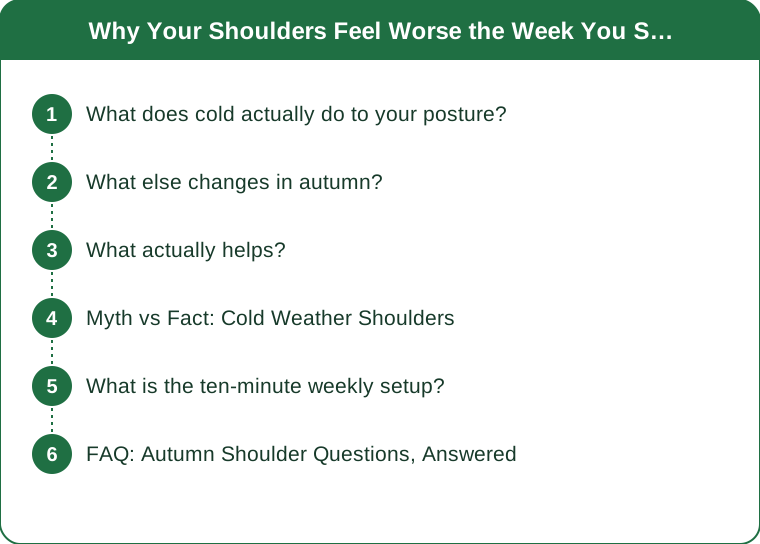
What does cold actually do to your posture?
It produces bracing, which is an involuntary response rather than a habit.
When you are cold, your body reduces surface area and increases muscle tone. In practical terms your shoulders rise toward your ears, your head comes forward, and your upper back rounds. It is the same protective posture across the whole population and it is not something you decide to do.
The muscles doing that work — upper trapezius and levator scapulae, the ones running from the top of the shoulder up to the neck — are the exact muscles people describe as tight when they say their shoulders hurt.
The problem is duration rather than intensity. Holding a mild elevation for eight hours produces more accumulated fatigue than holding a strong one for ten minutes. A cold commute, a cold office, and a cold walk home add up to a large fraction of the day in that position.
And it compounds: fatigued muscles hold more resting tension, which reduces circulation, which increases the sensation of tightness, which produces more guarding.
What else changes in autumn?
Three things, all of which load the same area.
Your coat weighs something. A winter coat adds real weight, and that weight hangs from your shoulders for however long you wear it. It is not much per hour and it is continuous.
Your bag behaves differently. A bag strap on a smooth coat slides constantly, and your response is to hitch the shoulder up to hold it there. That hitching is a sustained contraction of exactly the muscle that is already fatigued. It is one of the most common and least noticed contributors.
Hands go in pockets. This changes shoulder position substantially — internally rotating the arm, pulling the shoulder forward, and removing the natural arm swing that keeps the shoulder girdle moving through range. Hours of walking without arm swing is a real reduction in movement variety.
There is also less general movement overall. People spend more time indoors and sedentary as the weather turns, and the shoulder complex is one of the areas that most depends on regular movement to feel normal.
What actually helps?
The interventions that address duration and position, rather than stretching harder.
Use a crossbody bag or a backpack. This removes the hitching contraction entirely and is the single highest-return change on the list. If a shoulder bag is non-negotiable, switch sides deliberately and often.
Get gloves and take your hands out of your pockets. Restoring arm swing while walking gives your shoulder girdle a regular movement cycle it currently is not getting.
Warm the area, genuinely. A scarf that covers the base of the neck and the top of the shoulders reduces the cold stimulus that drives the bracing in the first place. This addresses the cause rather than the symptom and works better than most people expect.
Break the position every hour. Not a stretch — a movement. Shoulder rolls, arms overhead, a doorway chest opener for twenty seconds. The goal is variety rather than length.
Check your desk setup for the season. People pull chairs closer and hunch more in cold rooms, and a workstation that was fine in July can be contributing by October.
As general information rather than medical advice: tightness that is symmetrical and eases with movement is typical. Pain that radiates down an arm, involves numbness or tingling, or is one-sided and worsening is a different situation and worth having assessed.

Myth vs Fact: Cold Weather Shoulders
Myth: You need to stretch more. Fact: Stretching a muscle that is chronically fatigued from sustained low-level contraction gives short-term relief and does not address the cause. Reducing the hours spent in the position does. Stretching is useful alongside that, not instead of it.
Myth: It means your posture is bad. Fact: It means your posture has been in one position for a long time. Position variety matters more than position quality — a person who moves through several imperfect positions generally feels better than one holding a textbook position all day.
Myth: A heavier coat is the problem and a lighter one solves it. Fact: Coat weight is a contributor and usually a minor one compared with the bracing and the bag. A lighter coat that leaves you cold makes the bracing worse, which is a net loss.
Myth: Massage fixes it. Fact: Massage genuinely helps symptomatically and the relief is temporary if the daily loading pattern is unchanged. It works well in combination with changing the bag and adding movement breaks, and poorly on its own.
Myth: Strengthening exercises will prevent it. Fact: Strengthening the mid-back and the muscles that hold the shoulder blade down is genuinely useful and worth doing. It does not override eight hours a day of elevation, so it belongs alongside the positional changes rather than as a substitute.
What is the ten-minute weekly setup?
Done once, this covers most of the season.
- Switch to a crossbody bag or backpack and check the strap length over a winter coat. A strap set for a t-shirt sits wrong over a coat and is the reason many people give up on crossbody in autumn
- Put gloves somewhere you will actually take them, which for most people means in the coat pocket rather than in a drawer
- Choose a scarf that covers the base of the neck. This is a warmth decision with a direct postural effect
- Set an hourly movement cue during work hours — a timer, or attach it to something that already happens. Ten seconds of shoulder rolls counts
- Add two mid-back exercises to whatever you already do. Rows and face pulls or band pull-aparts, twice a week. This is the strengthening side and it is genuinely worth the small time cost
- Re-check your desk chair height and monitor position now that you are indoors more
And one thing that pays off disproportionately: warm up before the walk, not after. Thirty seconds of shoulder rolls and arm circles before stepping out into cold air means you start the walk with the area mobile rather than already braced. It sounds too small to matter and it changes how the commute feels.
FAQ: Autumn Shoulder Questions, Answered
Why is it always worse on one side?
Usually the bag side, the mouse side, or the side you sleep on. Cold-weather bracing is symmetrical, so a consistently one-sided pattern points to a loading habit rather than to the weather. Switching sides for two weeks usually confirms it.
Should I use heat or ice?
For muscular tightness from sustained contraction, heat is generally more useful — it increases blood flow and reduces the guarding. Ice is more relevant to acute injury. A warm shower aimed at the upper back, or a heat pack for fifteen minutes in the evening, is a reasonable approach.
Does sleeping position matter for this?
It can, particularly side sleeping with the shoulder compressed underneath you or with an arm overhead. If you wake with it worse than when you went to bed, that is a clue. A pillow that keeps your head neutral rather than tilted, and a pillow hugged in front to stop the top shoulder rolling forward, are both worth trying before anything more involved.
TL;DR:
- Cold triggers involuntary shoulder elevation, and the problem is how many hours a day you hold it
- A sliding bag strap, hands in pockets, and coat weight all load the same already-fatigued muscles
- Switch to a crossbody or backpack, wear gloves so your arms swing, and use a scarf that covers the shoulder tops
- Movement variety every hour beats longer stretching, and mid-back strength work belongs alongside it
Nothing went wrong with your shoulders. They started spending several more hours a day in a shortened position, and the fixes are mostly logistical rather than therapeutic.
Keep Reading
This article is for general informational purposes only and is not medical advice. Always consult a qualified health professional for guidance specific to you.