Why Your Shoulder Hurts More in Cold Weather — and What Actually Helps
Quick Answer: Cold weather increases shoulder pain mainly through reduced tissue temperature making muscle and connective tissue stiffer, peripheral blood flow reduction, and behaviour change — you move less, hold more tension, and warm up less thoroughly. Barometric pressure is often blamed but the evidence for it is weak. The fixes that work are longer warm-ups, keeping the joint physically warm, and maintaining movement volume through winter.
The shoulder that was fine all summer starts aching in October. It is stiffer in the morning, it complains during overhead work, and it takes longer to warm up.
You have probably been told it is the barometric pressure, or that the cold gets into the joint.
Neither of those is quite what is happening, and the actual explanation points at things you can do something about.

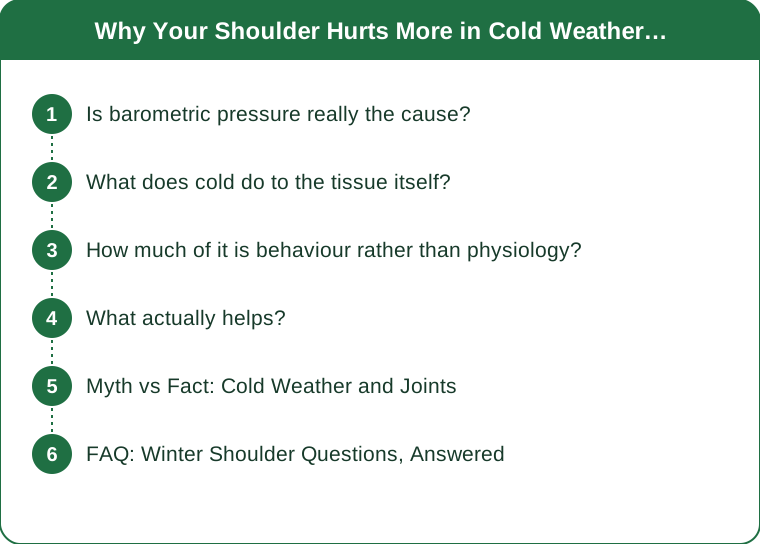
Is barometric pressure really the cause?
Probably not the main one, despite how universal the belief is.
Studies looking for a relationship between barometric pressure and joint pain have produced inconsistent and generally weak findings. Some show a small association, many show none, and the effect sizes where present are small.
The perception is real — people genuinely report more pain in cold weather, and consistently. What is doubtful is the mechanism, not the experience.
Temperature has much better support, and it works through several routes at once. So the correct summary is that weather does affect joints, but through cold and behaviour rather than pressure.
This matters practically. You cannot do anything about barometric pressure, and you can do quite a lot about tissue temperature — so attributing it to pressure removes the fixes.
What does cold do to the tissue itself?
Three things that compound.
Muscle and connective tissue get stiffer as they cool. Tissue viscoelasticity is temperature dependent, so cold tissue resists deformation more and returns to shape more slowly. That is felt directly as stiffness and as a smaller comfortable range of motion.
Blood flow to the periphery reduces. Your body prioritises core temperature by constricting peripheral vessels, which means less blood to the shoulder — less oxygen delivery and slower removal of metabolic byproducts.
Muscles hold more baseline tension in the cold. Shivering is the obvious version, but there is a subtler increase in resting tone, and the upper trapezius and shoulder girdle are among the first places people carry it.
Together these mean a cold shoulder starts every movement from a stiffer, less well-supplied, more tense baseline than a warm one. The joint has not changed; its operating conditions have.
How much of it is behaviour rather than physiology?
A large share, and it is the most fixable part.
Total movement drops in winter. Fewer outdoor activities, shorter walks, more sitting. Joint health depends on movement — synovial fluid distribution and cartilage nutrition both rely on load cycling — so less movement means stiffer joints independent of temperature.
Posture changes in the cold. Shoulders elevate and round forward, which is a protective huddle. Hold that for hours and the shoulder girdle sits in a position that irritates the structures passing under the acromion.
Warm-ups get shortened. In a cold gym, people want to start the working set sooner. That is precisely backwards — cold tissue needs a longer warm-up, not a shorter one.
Bag and coat weight increases. Heavier coats, more carried, often on one shoulder. It is a small load, applied for hours, on a joint already in a compromised position.

What actually helps?
Five things, roughly in order of return.
Extend the warm-up substantially. In cold conditions, 10 to 15 minutes before loaded overhead work rather than the 5 you use in summer. Start with general circulation work, not shoulder-specific stretching — you want tissue temperature up before you ask for range.
Keep the joint physically warm. A long-sleeve layer during training, a warm layer between sets, and covering the shoulder outdoors. Simple, and it directly addresses the actual mechanism.
Maintain movement volume through winter. Whatever your autumn baseline was, protect it. Consistency matters more than intensity here — a short daily mobility routine beats an occasional long session.
Address the posture, not just the joint. Thoracic extension and scapular work do more for winter shoulder complaints than shoulder stretching, because the rounded-forward position is what closes the space the tendons pass through.
Heat before, not after. A hot shower or a heat pack before activity raises tissue temperature and improves compliance. Ice is for acute inflammation, not for stiffness.
Myth vs Fact: Cold Weather and Joints
Myth: the cold gets into the joint. Fact: your core and deep joint structures stay at body temperature. What cools is the surface tissue, muscle and superficial connective tissue — which is where the stiffness comes from, and which is why external warmth genuinely helps.
Myth: pain in cold weather means arthritis. Fact: cold-related stiffness is extremely common in people with entirely healthy joints. Increased stiffness is not diagnostic of anything on its own — persistent pain, night pain or a loss of range is what warrants assessment.
Myth: stretching a cold shoulder loosens it up. Fact: stretching cold tissue is less effective and less comfortable than warming it first. Raise tissue temperature with movement, then work on range.
Myth: you should rest a shoulder that aches in winter. Fact: reduced movement is part of the cause. Modifying load is sensible; stopping entirely usually makes the pattern worse over a season.
Myth: supplements fix winter joint pain. Fact: the evidence for most joint supplements is weak to mixed. Warm-up duration, movement volume and keeping the joint warm have far better returns and cost nothing.
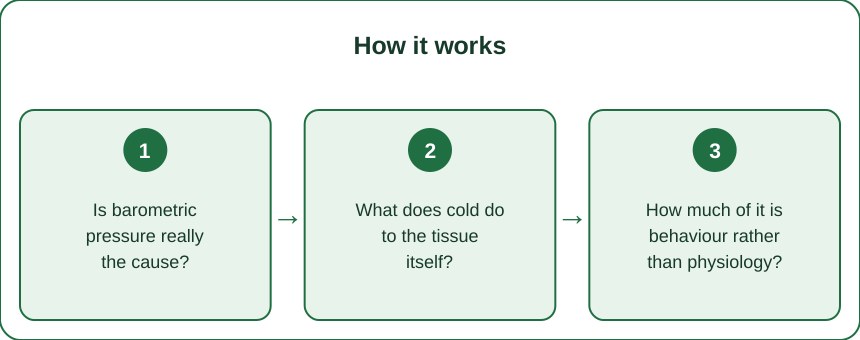
FAQ: Winter Shoulder Questions, Answered
How long should a cold-weather warm-up actually be?
10 to 15 minutes before anything loaded overhead, versus perhaps 5 in warm conditions. Spend the first half raising general body temperature — you are trying to warm tissue, and shoulder circles do not do that on their own. You should feel genuinely warm before the first working set.
Does a heat pack before training actually help?
Yes, for stiffness specifically. Superficial heat improves tissue compliance and comfortable range of motion, and 10 to 15 minutes before activity is a reasonable protocol. It does not replace an active warm-up — it makes it more effective.
When should I get this looked at?
If you have pain at night, pain that wakes you, a loss of range you cannot warm out of, weakness, or symptoms persisting beyond a few weeks despite sensible warm-ups. Seasonal stiffness that improves with 15 minutes of movement is a different thing from a shoulder that is not working. This is general information, not medical advice — see a physiotherapist or doctor for a shoulder that is not settling.
TL;DR:
- Barometric pressure is the usual explanation and the weakest one. Temperature and behaviour are far better supported.
- Cold tissue is stiffer, less well perfused and holds more tension — the joint has not changed, its operating conditions have.
- Warm up for 10 to 15 minutes in cold conditions, keep the shoulder physically warm, and use heat before rather than ice after.
- Protect your movement volume through winter and work on thoracic extension, not just the shoulder itself.
Seasonal stiffness that warms out in 15 minutes is normal. Night pain, weakness, or lost range that does not warm out is worth having assessed. This is general information, not medical advice.
Keep Reading
This article is for general informational purposes only and is not medical advice. Always consult a qualified health professional for guidance specific to you.