Why Your Shoulders Feel Tightest First Thing in the Morning
Quick Answer: Overnight stiffness comes from three things: joint fluid becomes more viscous and tissue swells slightly during hours of immobility, your sleep position holds the shoulder at an end range for long stretches, and the tissue simply has not moved. It is usually a mobility-and-position issue, not a damage signal. The fix is gentle repeated movement within five minutes of waking plus a position change, not aggressive stretching.
Almost everyone assumes morning stiffness means something is wrong. In most cases it means something entirely ordinary happened: your shoulder held one position for seven hours.
The distinguishing feature of benign morning stiffness is that it improves with movement, usually within 15 to 30 minutes. Stiffness that lasts longer than an hour, or that comes with swelling, redness, or persistent night pain, is a different conversation and worth a doctor’s opinion. This is general information, not medical advice.

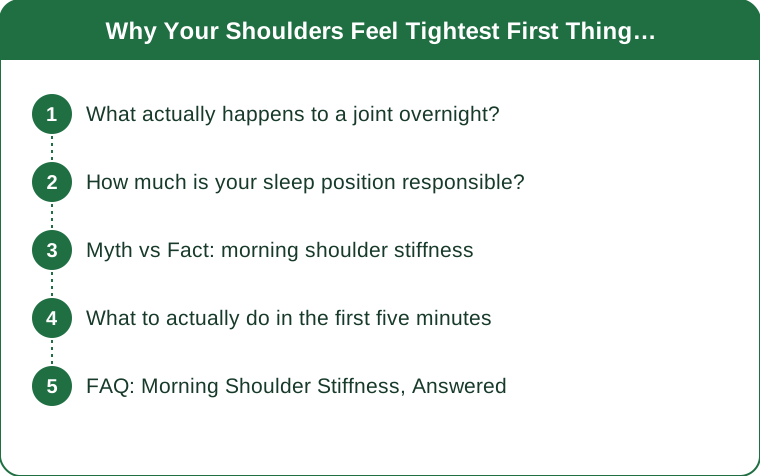
What actually happens to a joint overnight?
Three separate processes, all of them normal.
Synovial fluid changes behavior. The fluid lubricating your joints is thixotropic — it becomes thicker and more resistant when undisturbed and thins with movement. After hours of stillness, the joint is genuinely operating in a more viscous environment, which is why the first few rotations feel gritty and the tenth feels fine.
Mild fluid accumulation. Lying still reduces the muscular pumping that normally moves fluid out of tissue. A small amount of interstitial fluid accumulates around joints overnight, which produces a sensation of fullness and restriction. This is the same reason your hands can feel puffy on waking.
Tissue adapts to the held position. Connective tissue accommodates to sustained positions. Seven hours with the shoulder internally rotated and the arm across the body — the classic side-sleeper posture — means the tissues at the back of the shoulder have been held long, and the front held short, all night.
None of these are injuries. All three resolve with movement, which is why the sensible response is to move rather than to stretch aggressively into a joint that is currently at its stiffest and least lubricated.
How much is your sleep position responsible?
Often most of it, and it is the easiest variable to test.
Side sleeping on the affected shoulder compresses the joint under your body weight for hours and holds it in internal rotation. If one shoulder is consistently worse than the other, this is almost always why — check which side you wake up on.
Arm overhead or under the pillow puts the shoulder at end-range elevation for the whole night. This position is strongly associated with morning shoulder and arm symptoms, including numbness, because it narrows the space through which nerves and vessels pass.
Stomach sleeping with the head turned loads the neck and one shoulder asymmetrically. This one tends to produce upper trapezius and neck tightness that people attribute to their desk.
The test is simple and takes a week. Place a pillow to make rolling onto the bad shoulder harder, and hug a second pillow to keep the top arm supported rather than draped across your body. If the morning stiffness drops noticeably, you have your answer — and you did not need any exercises at all.
Mattress and pillow height matter too. A pillow too flat for a side sleeper lets the head drop and the shoulder compress; too high and the neck is laterally flexed all night. The target is a pillow that keeps the head level with the spine.

Myth vs Fact: morning shoulder stiffness
Myth: Stiff means tight, and tight means it needs stretching. Fact: Morning stiffness is largely fluid and position, not shortened muscle. Aggressive static stretching into a cold, under-lubricated joint frequently makes the shoulder more irritable rather than less. Gentle repeated movement through range is the better tool.
Myth: If it hurts in the morning, I should not train that day. Fact: Stiffness that clears within half an hour of moving is not a contraindication to training. Pain that persists once you are warm, or that worsens with specific movements, is worth attention.
Myth: I must have slept wrong. Fact: Sometimes literally true, in that position matters — but the phrase implies a one-off injury. Recurring morning stiffness is a pattern, and patterns come from habitual positions plus daytime posture, not from a single bad night.
Myth: It is a rotator cuff tear. Fact: Rotator cuff pathology typically produces pain with specific movements — reaching overhead, behind the back, or lying on it at night — rather than diffuse stiffness that resolves with a few minutes of movement. Night pain that wakes you up is the symptom that warrants an assessment, not morning stiffness that clears.
Myth: It means I am getting old. Fact: Morning stiffness increases somewhat with age, but the largest contributors remain position, daytime movement variety, and overall activity — all of which are modifiable at any age.
What to actually do in the first five minutes
Movement, gentle and repeated, before you do anything else.
Do these sitting on the edge of the bed, before coffee:
Shoulder rolls, 10 each direction. Slow, full circles. The goal is circulation and fluid movement, not stretch.
Pendulum swings, 30 seconds each arm. Lean forward slightly, let the arm hang, and swing it gently in small circles. This decompresses the joint and is one of the most reliably useful movements for a stiff shoulder.
Arms overhead and down, 10 reps. Slow, within comfortable range. Do not force the end range.
Cross-body reach, 10 each side. Gentle, no pulling with the other hand at this stage.
Wall slides or scapular circles, 10 reps once you are standing.
The whole sequence takes about three minutes and most people find the stiffness is largely gone by the end of it.
Later in the day is when to stretch, not now. Static stretching is far more effective and better tolerated on a warm joint. If you want a dedicated mobility session, do it after activity in the afternoon or evening.
And address the daytime side of it. Morning stiffness is worse in people who spend the day in one position. Shoulder health depends more on movement variety across the whole day than on any morning routine — a few minutes of range of motion every couple of hours beats a single dedicated session.
FAQ: Morning Shoulder Stiffness, Answered
How long is too long for morning stiffness to last?
As a rough guide, stiffness that resolves within 30 minutes of moving is typical. Stiffness lasting more than an hour, particularly in multiple joints, is worth mentioning to a doctor, since prolonged morning stiffness is one of the features associated with inflammatory conditions.
Should I use heat in the morning?
Heat helps, and it fits the mechanism — warmth reduces fluid viscosity and increases tissue compliance. A warm shower before your movement sequence is a reasonable and pleasant version of this.
Why is it worse on days after I train?
Delayed onset muscle soreness peaks 24 to 48 hours after unfamiliar training and adds to the baseline stiffness. That combination is normal. If it is severe or persists past three days, the training load was probably too big a jump.
TL;DR:
- Overnight stiffness comes from thickened joint fluid, mild fluid accumulation, and tissue held in one position — not from damage.
- Sleep position is usually the biggest single factor; check which side you wake up on and stop sleeping with the arm overhead.
- Gentle repeated movement in the first five minutes beats aggressive stretching into a cold joint.
- Save static stretching for later in the day when the tissue is warm, and prioritize movement variety across the whole day.
- Stiffness lasting over an hour, or night pain that wakes you, is worth a doctor’s opinion.
Try the pillow change for a week before you try anything else. It is free, it takes no time, and for a lot of people it is the whole answer. This is general information, not medical advice.
Keep Reading
This article is for general informational purposes only and is not medical advice. Always consult a qualified health professional for guidance specific to you.