Why Your Shoulder Only Hurts During Overhead Press (Not Other Lifts)
Quick Answer: Shoulder pain specific to overhead pressing (not other lifts) usually points to impingement — reduced space in the shoulder joint that only becomes a problem at end-range overhead positions. Scapular mobility and pressing angle are the first things to check.
If your shoulder is fine on bench, fine on rows, and only complains during overhead press, that specificity is actually useful information — it points toward a positional issue rather than a general shoulder problem.

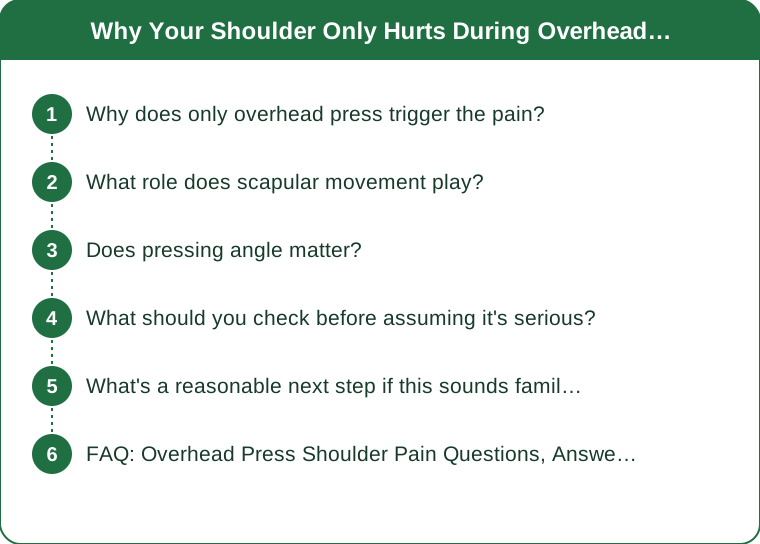
Why does only overhead press trigger the pain?
Overhead pressing requires your shoulder blade to rotate upward and your arm to reach full overhead range — a position other common lifts simply don’t demand. Shoulder impingement, where tendons get compressed in a narrowed space, typically only shows up at this specific end-range position, which explains why other lifts stay pain-free.
What role does scapular movement play?
If your shoulder blade doesn’t rotate upward properly as your arm goes overhead, the space available for your rotator cuff tendons narrows at exactly the top of the press — this is one of the most common mechanical causes of overhead-specific pain, and it’s a mobility and motor-control issue, not necessarily a strength one.
Does pressing angle matter?
Yes significantly — a completely vertical press path (barbell straight overhead) demands more shoulder range than a slightly forward-leaning angle (like a landmine press or slightly angled dumbbell press). Adjusting the angle temporarily can let you keep training the movement pattern while working on the underlying mobility issue.

What should you check before assuming it’s serious?
Test whether the pain is consistent at a specific point in the range (usually near the top) versus present throughout the whole movement — a specific-point pain pattern is more consistent with impingement, while pain throughout the whole range or pain that’s also present at rest deserves a professional look sooner rather than later.
What’s a reasonable next step if this sounds familiar?
Reduce range of motion temporarily (press to just below the point where pain starts), work on thoracic spine and shoulder mobility drills, and consider a physical therapy evaluation if the pattern persists more than 2-3 weeks despite these adjustments — this is general information, not medical advice.
FAQ: Overhead Press Shoulder Pain Questions, Answered
Should I keep pressing through mild discomfort?
Sharp or worsening pain is a stop signal; mild, consistent discomfort that doesn’t worsen might be manageable with reduced range, but persistent issues are worth a professional evaluation rather than pushing through indefinitely.
Does grip width on the bar matter?
Yes — a grip slightly wider than shoulder width can reduce some end-range strain compared to a very narrow grip for people with this specific pain pattern.
Will improving shoulder mobility elsewhere fix this?
Often partially — thoracic spine mobility specifically (not just shoulder-joint mobility) plays a bigger role in overhead position than most lifters realize, so it’s worth addressing both areas.
TL;DR:
- Pain specific to overhead press points toward impingement at the joint’s end range, not general shoulder issues
- Scapular upward rotation and thoracic mobility both affect available space in that position
- A less vertical pressing angle can reduce strain while you address the root mobility issue
- Pain confined to a specific point in the range is different from pain throughout — the pattern matters
The fact that only one lift hurts is useful diagnostic information — use it rather than avoiding overhead work entirely.
Keep Reading
This article is for general informational purposes only and is not medical advice. Always consult a qualified health professional for guidance specific to you.