Why Your Shoulder Feels Worse on the Days You Do Nothing
Quick Answer: Training days involve warm-up, full range movement, and increased blood flow to the shoulder. Rest days often involve eight sustained hours in a fixed forward position with none of that. For many people the rest day is the higher-load day for the shoulder complex — it’s just a static load rather than a dynamic one.
You take a day off to let your shoulder recover and it’s stiffer by evening than it was after Tuesday’s session. That’s a common and confusing pattern, and it usually means the thing irritating it isn’t the training.

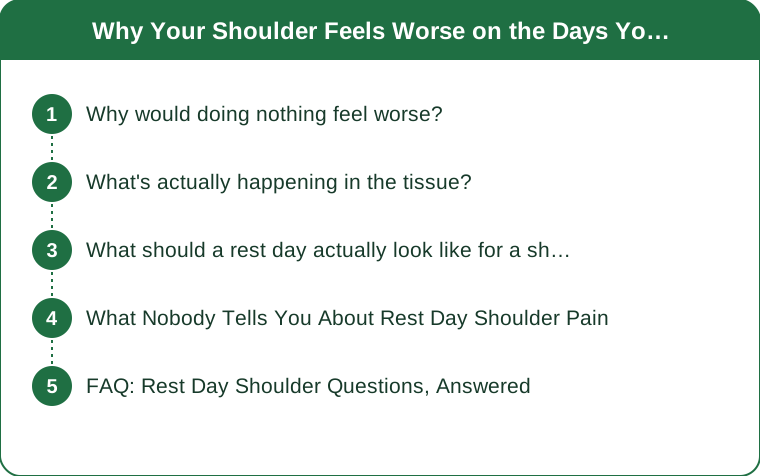
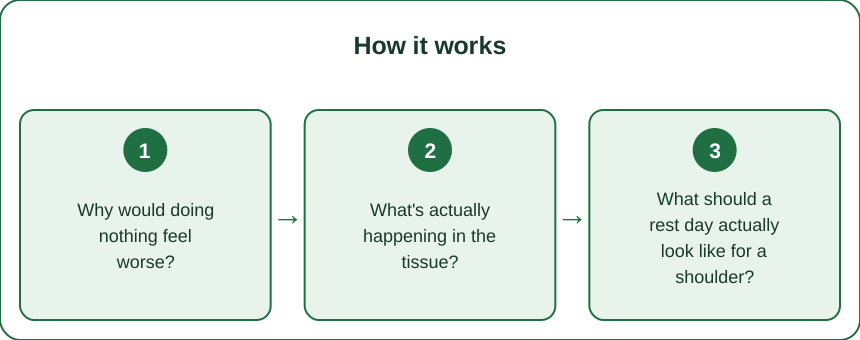
Why would doing nothing feel worse?
Because nothing isn’t nothing — it’s a sustained static position, and shoulders tolerate those poorly.
Static loading versus dynamic loading. A shoulder moving through full range under load gets blood flow, joint lubrication, and varied tissue stress. A shoulder held at 30 degrees of forward flexion for four hours gets sustained tension in the same tissues with no variation and reduced circulation.
Training days include things rest days don’t. A warm-up. Full overhead range. Scapular movement in multiple directions. Those aren’t just preparation for the session — they’re the most complete movement your shoulder gets all week, and removing them removes a real benefit.
The postural default is the problem. Sitting at a desk, driving, and using a phone all place the shoulder in protraction and internal rotation. Eight hours of that produces measurable adaptive changes in tissue length and stiffness — and rest days typically contain more of it, not less, because you’re not breaking it up with a gym trip.
The diagnostic value
If your shoulder is consistently worse on rest days, that’s genuinely useful information: it points away from training load as the cause and toward posture, sleep position, or sustained daily positioning.
What’s actually happening in the tissue?
Several things, none of which require an injury to explain.
Reduced circulation in sustained positions. Blood flow to tendon tissue is relatively low to begin with and drops further under sustained compression. Long static holds reduce the delivery of what the tissue needs.
Adaptive shortening. Tissue held short for long periods adapts to that length. Pectoralis minor is the usual suspect — held short in a forward posture, it tips the scapula forward, which changes the space available for the rotator cuff tendons to move through.
Reduced synovial circulation. Joint fluid distributes through movement. A joint that doesn’t move gets less of it.
Sensitization from sustained low-grade tension. Constant mild tension in a tissue can increase its sensitivity over hours, which is why the discomfort often builds through the afternoon rather than appearing suddenly.
None of this indicates damage. It indicates a position problem, which is considerably more fixable.

What should a rest day actually look like for a shoulder?
Not complete rest — reduced load with maintained movement.
Three to five movement breaks, 60-90 seconds each. Distributed through the day rather than concentrated. Frequency matters much more than duration here.
What to do in them: arms overhead and reach, shoulder blades back and down, gentle rotation in both directions, and one movement that opens the chest — a doorway stretch or hands clasped behind the back. That’s the whole protocol.
One longer session if you can. Ten minutes of light band work — external rotations, face pulls, scapular retractions — at genuinely light resistance. This is loading, but it’s the kind that helps rather than the kind that accumulates.
Change position more often than you think you need to. The best available intervention isn’t a stretch, it’s variation. Standing for twenty minutes, then sitting differently, then standing again, does more than any single stretch.
What to avoid on a rest day
Aggressive stretching of something already irritated. Sustained end-range stretching on a sensitized shoulder frequently makes the next day worse. Gentle and frequent beats intense and occasional here.
Long phone sessions. The forward head plus internally rotated shoulder position is the most concentrated version of the problem, and it’s the most common rest-day activity.
What Nobody Tells You About Rest Day Shoulder Pain
Sleep position may be the biggest single factor. Seven hours on one side compresses that shoulder continuously. If your discomfort is consistently one-sided and worst in the morning, sleep position is the first thing to examine — and a pillow between the arm and torso often changes it within a week.
Weekend pain patterns tell you about weekdays. If it’s worse on Saturday and Sunday, and you spend those days on a laptop on the sofa, the sofa is the variable. Sofa posture is considerably worse than desk posture for shoulders.
The forward head position loads the shoulder too. It isn’t only a neck issue — head-forward posture changes scapular position, which changes where the shoulder sits in its socket. Fixing head position often resolves shoulder symptoms that seemed unrelated.
Training may be masking it. If your shoulder feels best right after a session, that’s partly circulation and partly the analgesic effect of exercise. Feeling good after training doesn’t confirm the training is fine — it can hide an accumulating problem.
A pattern that persists past a few weeks deserves assessment. Rest-day-worse discomfort is usually positional, but persistent shoulder pain, night pain, weakness, or pain with specific movements warrants a professional look. This is general information, not medical advice.
FAQ: Rest Day Shoulder Questions, Answered
Should I train through it if it feels better when training?
Light, controlled work is usually fine and often helps. Heavy overhead loading on a shoulder that’s uncomfortable at rest is worth pausing on until you’ve addressed the positional side.
How long before posture changes make a difference?
Movement breaks often produce noticeable change within a week. Actual tissue adaptation takes longer — six to twelve weeks of consistent change.
Is a standing desk the answer?
Partly. Standing with the same forward shoulder position produces similar problems. The benefit comes from alternating, not from standing itself.
Why is it always worse in the afternoon?
Cumulative time in a sustained position. The tissue tension and sensitization build through the day, which is why morning is usually the best it feels.
Does a foam roller help?
Gently, on the upper back rather than directly on the shoulder. Improving thoracic extension changes scapular position, which helps the shoulder indirectly.
TL;DR:
- Rest days replace full-range loaded movement with eight hours of static forward positioning
- Training days include warm-up, overhead range, and circulation that rest days remove
- Take three to five 60-90 second movement breaks — frequency beats duration
- Vary position rather than searching for one correct posture
- Check sleep position first if discomfort is one-sided and worst in the morning
A shoulder that’s worse on rest days is telling you something specific: the problem is what you do for eight hours, not what you do for one. This is general information, not medical advice.
Keep Reading
This article is for general informational purposes only and is not medical advice. Always consult a qualified health professional for guidance specific to you.