Why Your Shoulder Feels Fine Until You Carry Something for Ten Minutes
Quick Answer: Carrying is a sustained isometric hold, which is a completely different demand from a set of ten repetitions. The small stabilisers around the shoulder blade fatigue within minutes under continuous low load, and once they give up, the joint hangs on passive structures instead. That is what produces the ache. The fix is endurance work — long holds and carries — not heavier pressing.
You can press a respectable weight overhead.
Ten minutes with a shopping bag and your shoulder is unhappy for hours.
Those two facts are entirely compatible.

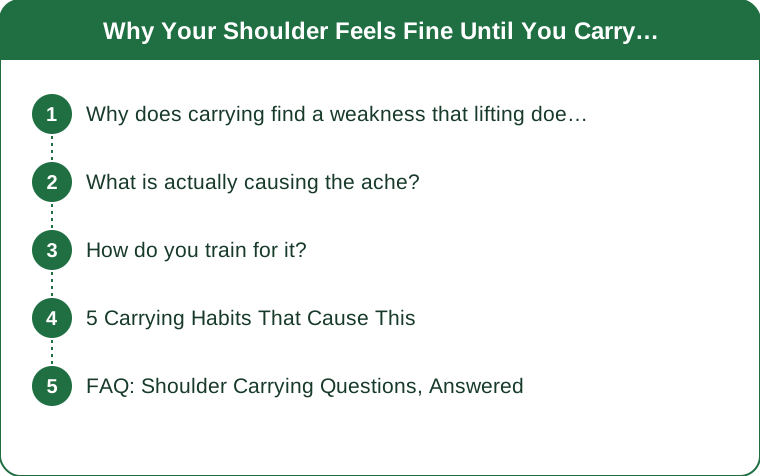
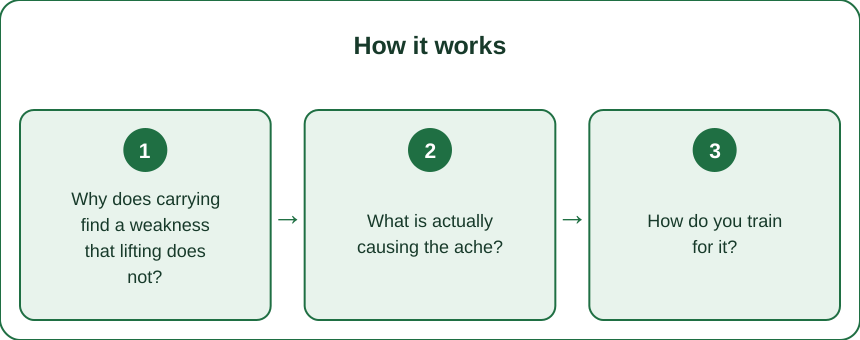
Why does carrying find a weakness that lifting does not?
Because the demand is time, not load.
Carrying is a continuous isometric hold. A set of ten presses lasts thirty seconds. Carrying a bag home lasts ten minutes. The tissue demand is not remotely comparable.
Postural stabilisers fatigue quickly. The lower trapezius, serratus anterior and rotator cuff muscles that position the shoulder blade are endurance-oriented and rarely trained that way.
Continuous load restricts blood flow. Sustained low-level contraction compresses the muscle’s own circulation, so it fatigues faster than intermittent work at the same intensity.
Once stabilisers fatigue, position degrades. The shoulder blade tips forward, the joint sits differently, and structures that are not designed to bear load start taking it.
The load pulls downward and distracts the joint. Hanging weight is a traction force, which is a different stress from the compression of pressing.
And you carry asymmetrically. One side, one bag, the same side every time. Nobody presses that way.
What is actually causing the ache?
Three mechanisms, all downstream of the same fatigue.
Passive structures taking load. When active support fatigues, capsule, ligaments and tendons carry the weight. They tolerate it poorly and complain afterwards rather than during.
Position change under the acromion. A tipped shoulder blade reduces available space for the tendons passing through, which produces the classic ache at the top and outside of the shoulder.
Neck involvement. Upper trapezius takes over when lower trapezius fatigues, which is why carrying-related shoulder pain so often comes with neck tightness on the same side.
Delayed onset is characteristic. Fine during, sore afterwards, worse that evening. This pattern points at endurance failure rather than acute injury.
It is usually one side. Whichever side you carry with, which is also usually your dominant side.
Seasonal note: this typically worsens in autumn and winter, when a coat restricts shoulder movement, a bag strap sits over more layers and slips more, and you shrug against the cold. Cold-weather shoulder ache that appears with the first coat of the season is usually this, not a new problem.

How do you train for it?
Endurance and position, in that order.
Farmer’s carries are the direct answer. Walk with a weight in each hand for 40 to 60 seconds, 3 to 4 sets. Start light enough that your posture holds throughout — the point is duration, not load.
Suitcase carries train the asymmetry. One hand only, resisting the side bend. 30 to 45 seconds per side. This is the single most specific exercise for a one-sided carrying problem.
Long holds beat heavy reps. Add sustained-position work: a 60-second overhead hold with a light weight, or a plank with a shoulder tap, rather than adding load to your press.
Strengthen the lower trapezius and serratus specifically. Prone Y raises, wall slides and scapular push-ups. These are the muscles that fail first, and almost nobody trains them.
Build tolerance progressively. If ten minutes causes trouble, carry for five, twice, with a break. Then six. Endurance responds to gradual exposure like anything else.
Expect four to six weeks. Endurance adaptations in small stabilisers take about that long to show up in daily life.
This is general information, not medical advice. Pain that persists, wakes you at night, comes with weakness or numbness, or follows a specific injury should be assessed by a physiotherapist or doctor.
5 Carrying Habits That Cause This
Always carrying on the same side. Predictable, universal, and the root of most one-sided shoulder problems. Swap every few minutes, not every few trips.
Letting the strap sit on the very top of the shoulder. It slides, you shrug to hold it, and upper trapezius works continuously for the whole journey.
Carrying one heavy bag rather than two lighter ones. Two balanced loads are considerably easier on the shoulders than one, even at the same total weight.
Long straps that let the bag swing. A swinging load requires constant correction from exactly the muscles that fatigue first.
Locking the elbow and hanging off the joint. A slightly engaged arm with the shoulder blade set down and back handles far more than a passively hanging one.
And the one that surprises people: carrying with your shoulders shrugged because you are cold or tense. It pre-fatigues the upper trapezius before the load is even on, which is precisely why the same shopping trip is harder in January than in June.
FAQ: Shoulder Carrying Questions, Answered
Why does it hurt after rather than during?
Endurance failure and passive-structure loading produce delayed symptoms. Acute injury usually hurts immediately.
Should I stop carrying things?
No. Reduce duration, then build back up. Complete avoidance removes the stimulus that builds tolerance.
Will heavier pressing fix it?
Unlikely on its own. This is an endurance problem, and endurance responds to duration.
How long should a carry be?
40 to 60 seconds per set for farmer’s carries, 30 to 45 seconds per side for suitcase carries. 3 to 4 sets.
Is a backpack better than a shoulder bag?
Almost always, because it distributes load symmetrically. A crossbody is the next best option.
Why does my neck hurt too?
Upper trapezius compensates when the lower trapezius fatigues. Neck and shoulder symptoms on the same side usually share a cause.
When should I get it checked?
If it persists beyond a few weeks of sensible loading, wakes you at night, or comes with weakness, numbness or tingling.
TL;DR:
- Carrying is a sustained isometric hold — a different demand from lifting reps, and it exposes endurance, not strength.
- Stabilisers fatigue within minutes; once they give up, passive structures take the load and ache afterwards.
- Train it with farmer’s and suitcase carries — 40 to 60 seconds, 3 to 4 sets — plus lower trapezius and serratus work.
- Swap sides every few minutes, and carry two balanced bags rather than one heavy one.
- Allow four to six weeks for endurance adaptations to show up in daily life.
Add two sets of suitcase carries to your next session. It targets exactly the thing your shopping bag is finding.
Keep Reading
This article is for general informational purposes only and is not medical advice. Always consult a qualified health professional for guidance specific to you.