Why Your Shoulder Feels Fine Pressing but Hurts Carrying Shopping
Quick Answer: Pressing is a compressive, short-duration task with the joint centred and stable. Carrying is a traction task - the weight hangs down and pulls the joint apart, for minutes at a time, with the arm at your side and the shoulder blade unsupported. Different direction, different duration, different muscles. Being strong overhead tells you almost nothing about your tolerance for hanging load, which is why the gap catches people out.
Here is what is doing the work in each case, and how to close the gap.

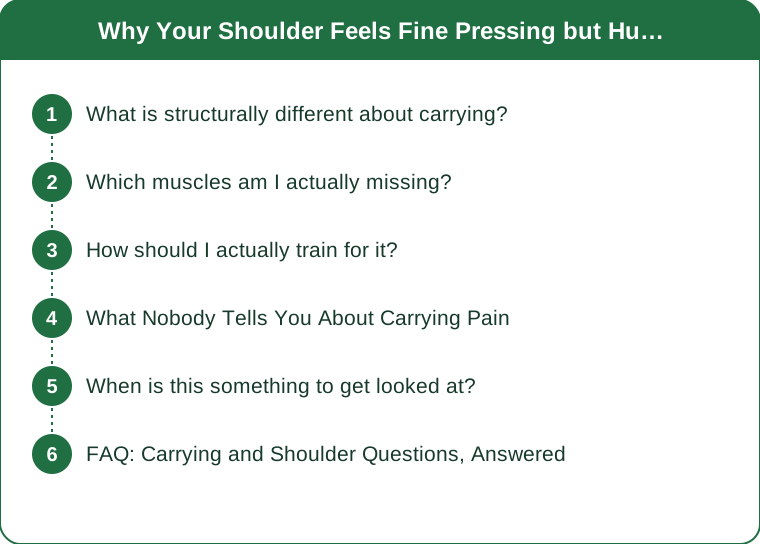
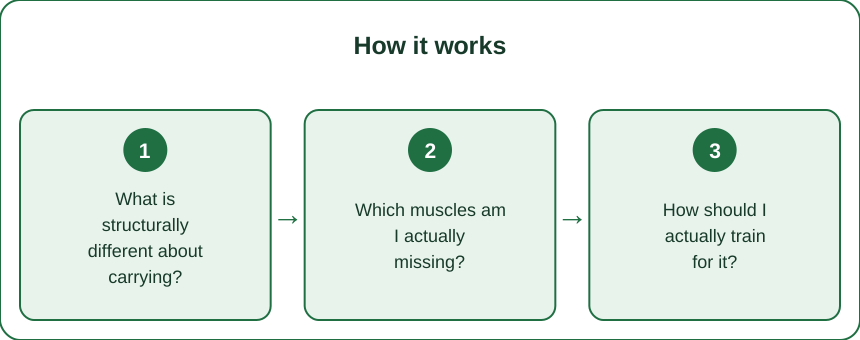
What is structurally different about carrying?
Pressing compresses the joint; carrying distracts it. Overhead pressing pushes the head of the humerus into the socket, which is a stable position actively supported by the rotator cuff. Carrying does the reverse - gravity pulls the arm down and away from the socket.
Distraction is held by different tissue. The upper trapezius, levator scapulae, and the joint capsule take the hanging load, along with the ligaments at the top of the shoulder - structures that barely participate in a press.
Duration is the other half of it. A set of presses is perhaps 30 seconds of work. Carrying shopping is four to ten continuous minutes of low-level tension, which is an endurance demand, not a strength one.
The scapula behaves differently too. In a press, the shoulder blade rotates upward and sets against the ribcage. Carrying with a relaxed posture lets it drift down and forward, which changes the angle of the joint and narrows the space the tendons pass through.
And carrying is usually one-sided. A press is symmetrical; a shopping bag is not. One-sided load creates a side-bend through the trunk, which changes shoulder mechanics further up the chain - and that asymmetry is the part people never train.
Which muscles am I actually missing?
Lower trapezius and serratus anterior are the usual suspects. These position the shoulder blade and are heavily trained by nothing in a typical pressing routine. Weak scapular control means the joint sits badly the entire time you carry.
Grip endurance is the sleeper. When your grip fatigues, you shrug to compensate - hoisting the whole shoulder to stop the bag slipping. That sustained shrug is what people feel as shoulder pain, and it originates at the hand.
Upper trap endurance, not upper trap strength. The upper trap is generally strong; what fails is its ability to hold a low-level contraction for minutes. Long-duration holds train it; heavy shrugs do not.
Rotator cuff in the neutral, arm-at-side position is trained far less than in the overhead one. Most cuff work happens with the arm elevated, which does not transfer well to a hanging load.
And the trunk matters more than people expect. Obliques and quadratus lumborum resist the side-bend a one-sided carry creates. If the trunk gives way, the shoulder absorbs the difference - which is why some shoulder pain is genuinely a core endurance problem.
How should I actually train for it?
Add loaded carries directly. There is no substitute. The demand is specific, and the training that fixes it looks like the task.
Farmer’s carry, both hands: 3 sets of 40 metres, weight heavy enough that the last 10 metres are genuinely hard. Twice a week. Keep the ribs down and the shoulder blade set back and slightly down - not shrugged, not slumped.
Suitcase carry, one hand: 3 sets of 30 metres per side. This is the direct rehearsal for shopping. Resist the side-bend - the trunk work is the point, not the arm work.
Then attack grip separately. Dead hangs from a bar, 3 sets of 20 to 40 seconds, or timed static holds with heavy dumbbells. When grip endurance improves, the compensatory shrug disappears on its own.
Scapular work, twice a week. Prone Y-raises with light weight, 2 sets of 12 with a 2-second hold at the top, and serratus work like a wall slide or push-up plus. Light and controlled beats heavy here.
And build the duration gradually. If four minutes hurts, start at 90 seconds and add 20 to 30 seconds a week. Tendon and capsule tolerance adapts more slowly than muscle strength, and rushing it is the most common way people re-aggravate this.

What Nobody Tells You About Carrying Pain
Bag design changes the load more than technique does. A single narrow handle concentrates force through a small area and forces a hard grip. A wide strap or two balanced bags changes the demand completely - and two lighter bags are usually easier than one heavy one, even at the same total weight.
Switching hands halfway is not enough. Most people switch once, after the first side is already fatigued. Switch every 60 to 90 seconds, before fatigue sets in, and the total tolerable duration rises noticeably.
The pain often shows up after you put the bag down. Sustained low-level tension produces a delayed ache, so people misattribute it to whatever they did next rather than the carry itself. Track the timing for a week and the pattern usually becomes obvious.
Cold weather makes it worse for a real reason. You hunch, you tense, and you carry with your shoulders elevated. The same shopping trip in October costs more than it did in July, which is why this complaint reliably increases in autumn.
And a rucksack solves most of it. Two straps, load close to the spine, no grip demand, no side-bend. If carrying is a persistent problem, the equipment answer is genuinely better than the training answer - though ideally you do both.
One more thing: if you can press pain-free but carrying hurts, that is actually useful diagnostic information. It points toward the capsule, the upper trap, or scapular control rather than the cuff itself, and that distinction is worth mentioning if you see a professional.
When is this something to get looked at?
Pain that shows up in a specific, repeatable position deserves attention if it persists. A few weeks of targeted work should produce noticeable change. If it does not, stop guessing.
Night pain is the clearest red flag. Shoulder pain that wakes you or prevents you lying on that side is a common feature of cuff pathology and is not something to train through.
Weakness rather than pain is the second. If you cannot hold a light weight out at your side, or the arm feels like it gives way, that is different from something that hurts and needs assessing.
Numbness, tingling, or pain travelling down the arm points toward the neck rather than the shoulder itself. Carrying loads the neck too, and this pattern is worth a professional opinion rather than more shoulder exercises.
Sudden onset with a specific incident - a slip, a catch, a heavy bag jerking the arm - deserves proper assessment rather than a home programme.
This is general information, not medical advice. A physiotherapist can test scapular control, cuff strength, and capsule mobility separately in about fifteen minutes, and that saves months of training the wrong thing.
FAQ: Carrying and Shoulder Questions, Answered
Why can I press overhead but not carry a bag?
Pressing compresses a centred, stable joint for seconds; carrying pulls the joint apart for minutes with the shoulder blade unsupported. Different direction, different duration, different muscles.
Should I stop carrying heavy things?
Not permanently - avoidance reduces tolerance further. Reduce the duration to what is comfortable, then build it back by 20 to 30 seconds a week.
Are shrugs the right exercise for this?
Not really. The upper trap usually has enough strength but not enough endurance. Long-duration carries and holds train the quality you are missing; heavy shrugs train the one you already have.
How long until carrying feels better?
Muscular endurance improves within two to three weeks. Tendon and capsule tolerance takes longer - usually six to twelve weeks of consistent, gradual loading.
Does a rucksack really help that much?
Yes. Two straps, no grip demand, load close to the spine, and no side-bend. For persistent carrying pain it is the most effective single change available.
Should I switch hands more often?
Yes - every 60 to 90 seconds rather than once at the halfway point. Switching before fatigue arrives, not after, meaningfully increases total tolerance.
TL;DR:
- Pressing compresses the joint; carrying pulls it apart for minutes at a time with the shoulder blade unsupported. Strength overhead does not transfer.
- The gaps are usually lower trap and serratus control, grip endurance, and trunk resistance to side-bend.
- Train it directly: farmer’s carries 3x40m, suitcase carries 3x30m per side, twice weekly, plus dead hangs for grip.
- Build duration by 20 to 30 seconds a week. Capsule and tendon tolerance adapts slower than muscle.
- Switch hands every 60 to 90 seconds, and prefer two balanced bags or a rucksack over one heavy handle.
- Cold weather genuinely makes it worse - you carry with elevated, tense shoulders.
Red flags: night pain, true weakness, numbness or pain down the arm, or a specific injury. See a professional. This is general information, not medical advice.
Keep Reading
This article is for general informational purposes only and is not medical advice. Always consult a qualified health professional for guidance specific to you.