Why Your Shoulder Feels Fine Lifting but Aches at Your Desk
Quick Answer: Loaded movement engages the rotator cuff and scapular stabilizers, which compresses and centers the joint and increases blood flow. Sustained static sitting does the opposite — the scapula drifts forward, subacromial space narrows, and the cuff tendons hold a low-grade sustained load with poor circulation. Pain under static posture with none under load usually points to a positional and endurance problem, not a strength or structural one.
You pressed a heavy dumbbell overhead this morning without a twinge. Now it’s 3pm, you’ve been typing for two hours, and the same shoulder is aching in a dull, spreading way that no lift ever produced.

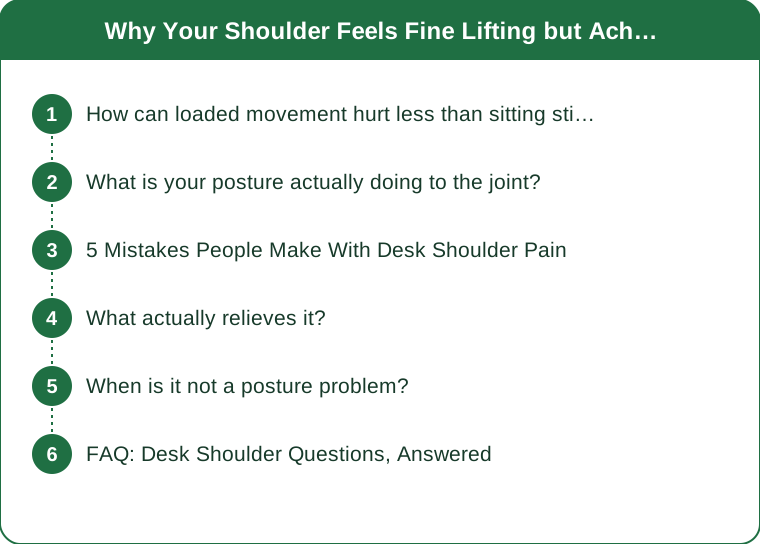
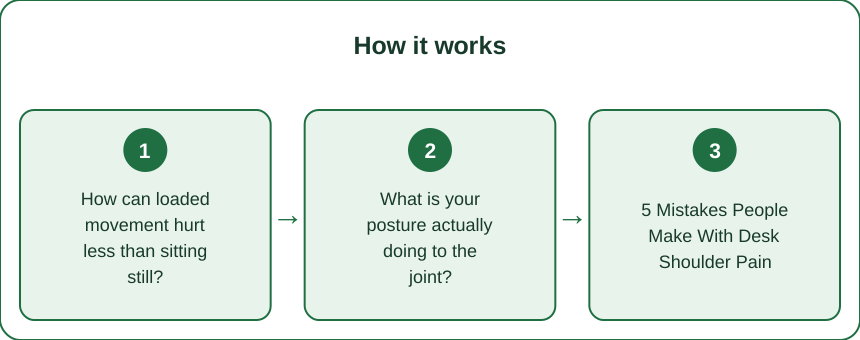
How can loaded movement hurt less than sitting still?
Because they’re different demands entirely.
When you lift, the rotator cuff fires hard, actively pulling the humeral head into the center of the socket. That’s what the cuff is for — it’s a centering mechanism far more than a lifting one. A centered joint has maximum clearance under the acromion, and blood flow through the muscles is high.
When you sit, none of that is happening. The scapula rotates forward and downward, the humeral head drifts anteriorly, and the subacromial space narrows measurably. The cuff tendons are now held in a compressed position for hours with minimal contraction and therefore minimal circulation.
Tendon tissue tolerates high loads for short periods far better than low loads for long periods. That’s the whole answer, and it’s why the pattern feels backwards.
What is your posture actually doing to the joint?
Three things, in sequence.
Forward head position shifts the load line. Every inch of forward head translation adds roughly 10 lb of effective load through the neck and upper trap chain, which pulls the scapula out of position.
Scapular protraction and anterior tilt follow. The shoulder blade slides forward around the ribcage and tips forward at the top, which physically reduces the space the cuff tendons pass through.
Internal rotation of the humerus completes it — hands on a keyboard hold the arms in internal rotation for hours, and that position further compresses the supraspinatus tendon.
Stack those three for two hours and you have a tendon under sustained mechanical compression with poor perfusion. That’s the ache.
5 Mistakes People Make With Desk Shoulder Pain
1. Stretching it more. The tissue usually isn’t short, it’s compressed and under-circulated. Aggressive stretching into the painful range often increases irritation.
2. Adding more pressing work. If the joint is already spending eight hours in a compressed position, more overhead volume isn’t the missing input.
3. Buying a chair and stopping there. No chair position is good for two hours. Position variety matters more than ideal position.
4. Waiting for it to become a lifting problem. By the time it hurts under load, the tendon has usually been irritated for weeks. The desk ache is the early warning, not a separate issue.
5. Doing mobility work only before workouts. The mobility you need is at 11am and 3pm, at the desk, not at 6pm in a gym.

What actually relieves it?
Movement frequency first, everything else second.
Every 30 minutes, do 10 scapular retractions. Sit tall, pull both shoulder blades back and slightly down, hold 3 seconds, release. It takes 40 seconds and it directly reverses the protracted position.
Add wall slides or a doorway reach twice a day — arms up the wall, elbows and wrists in contact, slide up and down 10 times. This restores upward scapular rotation, which is the specific motion that sitting removes.
Change the setup so the arms aren’t hanging unsupported. Forearms supported on armrests or the desk itself removes a substantial static load from the upper trap and cuff. Monitor at eye height fixes the forward head that starts the chain.
Train the lower trap and serratus separately from your pressing work — prone Y raises, serratus punches, and face pulls. These are the muscles that hold the scapula in position, and they’re endurance muscles, so higher reps at light load is the correct dose.
Give it three to four weeks of consistent frequency before judging. Positional problems resolve on a slower timeline than they appear.
When is it not a posture problem?
The pattern described here — no pain under load, aching under sustained static posture, better with movement — is the reassuring one.
Different signals worth taking seriously: night pain that wakes you, pain that’s worse rather than better after movement, a specific painful arc between roughly 60 and 120 degrees of raising the arm, weakness rather than just discomfort, or numbness and tingling down the arm.
Those can indicate rotator cuff tearing, frozen shoulder in its early phase, or a cervical spine source referring into the shoulder — which is common and frequently missed, because neck-referred shoulder pain often has no neck pain at all.
This is general information, not medical advice. If the ache persists past four to six weeks of consistent positional work, or if any of the signals above are present, see a physical therapist or physician for an assessment rather than continuing to self-manage.
FAQ: Desk Shoulder Questions, Answered
Should I stop lifting until it settles?
Usually no. Pain-free loaded movement is generally beneficial here — it’s the circulation and centering the joint is missing. What’s worth modifying is volume of overhead pressing and anything that reproduces the ache. Keep pulling work in.
Does a standing desk fix it?
Partly. It fixes the seated pelvis and often improves head position, but arms at a keyboard are still internally rotated and unsupported. Alternating positions every 30 to 45 minutes does more than either position alone.
Why is it always the same shoulder?
Usually the mouse side, or the side you lean on. Watch yourself for a day — most people have a consistent asymmetric setup they’ve never noticed, and the aching shoulder is the one doing the extra static work.
TL;DR:
- Loaded movement centers the joint and pumps blood; static sitting compresses it and starves it.
- Forward head, protracted scapula, and internal rotation stack up to narrow the subacromial space.
- Fix frequency of movement first — 10 scapular retractions every 30 minutes beats any single stretch.
- Night pain, weakness, or a painful arc means get it assessed rather than self-managing.
The reason this pattern confuses people is that we’re trained to think pain means damage from effort. Here it means the opposite: the shoulder is fine when you use it and unhappy when you don’t. Treat the desk as the training problem, and the gym stops being where you look for the answer.
Keep Reading
This article is for general informational purposes only and is not medical advice. Always consult a qualified health professional for guidance specific to you.