Why Your Shoulder Feels Better by the Second Set and Worse the Next Morning
Quick Answer: Warming up increases tissue temperature, synovial fluid flow, and pain modulation, so a cranky shoulder genuinely feels better by set two. That improvement is real but temporary — it does not mean the underlying irritation resolved. When symptoms return the next morning, that is the tissue reporting on the total load you gave it once the warm-up effect wore off.
Set one is uncomfortable. Set two is fine. By set four you have forgotten it hurt at all and you add weight.
The next morning you cannot reach the top shelf.

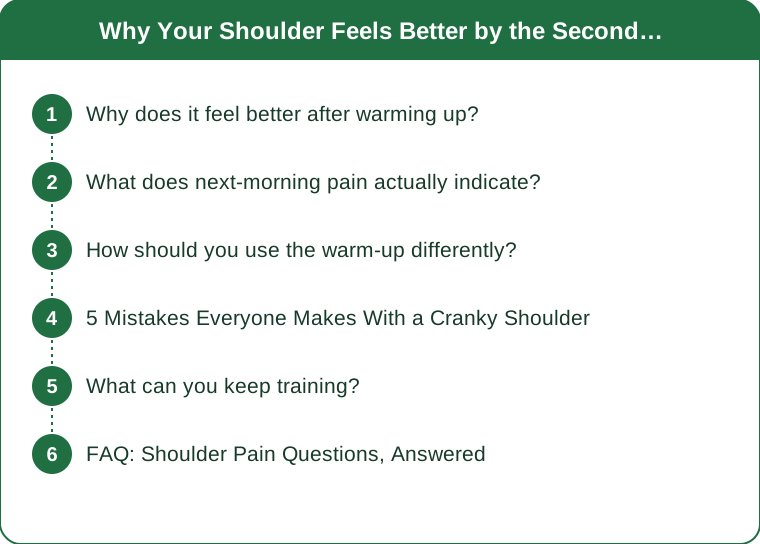
Why does it feel better after warming up?
Several genuine physiological changes, all temporary.
Synovial fluid becomes less viscous. Joint fluid thins with movement and temperature, which improves gliding and reduces the friction sensation many people describe as stiffness. This effect is real and it is why the first few reps of anything feel worst.
Tissue temperature rises, increasing tendon and muscle compliance. Warmer tissue tolerates load with less discomfort.
Pain modulation kicks in. Exercise produces a genuine analgesic effect through several mechanisms, and it is strong enough to mask moderate discomfort for the duration of a session.
Motor patterns improve. Your coordination and stabilization are better on set three than set one, which can genuinely reduce the irritating movement.
So the improvement is not imaginary and it is not just distraction. But three of those four effects are masking rather than fixing, and the fourth only helps while you are still coordinated.
Which means the feedback you get during a session is not a reliable guide to whether that session was a good idea for your shoulder.
What does next-morning pain actually indicate?
It is the signal that survived once the masking wore off, which makes it more informative than anything you felt mid-session.
The useful distinction:
Diffuse muscle soreness across the deltoid, pecs, or lats, symmetrical, easing with movement. Normal training soreness. Not a concern.
Localized ache at the front of the shoulder or deep in the joint, worse with specific movements — reaching overhead, behind your back, across your body. This is irritation rather than soreness, and it is the pattern that tends to accumulate over weeks if you keep training the same way.
Night pain, or pain that wakes you when you roll onto that side. This one deserves attention. It is one of the more consistent signals that something is being genuinely aggravated rather than just worked.
Weakness or a catching sensation rather than pain. Also worth having assessed rather than training around.
The pattern in the title — fine during, sore next morning, repeat — is one that people often run for months because each individual session felt acceptable. If that describes you, get it looked at by a physio rather than continuing to gather data. This is general information, not medical advice.
How should you use the warm-up differently?
Treat it as preparation, not as a test that grants permission.
The common approach is to warm up, notice the shoulder feels better, and take that as clearance to train normally. A more useful approach:
Decide your session before the warm-up. If the shoulder was sore this morning, plan a modified session and stick to it regardless of how good set two feels.
Warm up longer and more specifically. For a cranky shoulder, five to eight minutes of progressive work — band pull-aparts, external rotations, scapular slides, light presses — before anything loaded. Rushing the warm-up is what makes set one hurt in the first place.
Use a movement screen rather than a pain check. Before loading, test overhead reach, reach behind your back, and cross-body reach. If any is meaningfully limited compared to the other side, that is better information than whether pressing hurts.
Check again at the end. The most useful single data point is comparing that same screen after the session. If range decreased, the session was too much regardless of how it felt at the time.

5 Mistakes Everyone Makes With a Cranky Shoulder
1. Adding weight because it stopped hurting. The masking effect is strongest in the middle of a session, which is exactly when people decide to load up. Set your weights in advance.
2. Only working the shoulder itself. Shoulder irritation is frequently downstream of thoracic mobility and scapular control. If your upper back does not move, your shoulder makes up the difference. Thoracic extension and rotation work belongs in the warm-up.
3. Stretching into the painful range. The instinct to stretch a shoulder that feels tight often aggravates an already irritated structure. Tightness in a cranky shoulder is frequently protective rather than mechanical.
4. Skipping the pulling work. Pressing volume without matching pulling volume is one of the more common contributors. A rough guide is at least as much horizontal pulling as horizontal pressing, and many people benefit from more.
5. Waiting for it to resolve on its own for months. Shoulder issues that follow this pattern for more than a few weeks tend not to resolve without changing something. The change is usually straightforward — load management plus specific strengthening — but it requires actually making it.
What can you keep training?
Usually more than people assume, which matters because complete rest tends to make shoulders worse rather than better.
Generally well tolerated:
- Horizontal pulling — rows of most kinds, especially with a neutral grip
- Neutral-grip and landmine pressing, which reduce the overhead position
- Lower body work of every kind
- Carries, provided the shoulder is stable under load
- Isometric external rotation and scapular work
Commonly aggravating:
- Overhead pressing at full range
- Wide-grip bench and dips
- Behind-the-neck anything
- Upright rows
- Lateral raises past shoulder height
The adjustment that solves the most cases: reduce range rather than removing the movement. Pressing to eye level instead of overhead, or benching with a slightly narrower grip and a controlled depth, often keeps the training stimulus while removing the irritating position.
And build in the boring work. Two to three sets of external rotations and band pull-aparts, three times a week, is the single most commonly effective addition for the pattern described here.
FAQ: Shoulder Pain Questions, Answered
Is it okay to train through mild shoulder discomfort?
A common guideline is that discomfort up to about 3/10 that does not worsen during the session and settles within 24 hours is usually acceptable. Pain above that, pain that increases as you go, or pain lasting beyond a day is a signal to modify. The next-morning check is the honest one.
Why is it worse in the morning specifically?
Overnight, inflammatory fluid accumulates and the joint is immobile for hours, so stiffness and soreness peak on waking. This is normal for irritated joints generally and does not by itself indicate anything severe — but a shoulder that is reliably worse every morning after training days is telling you something about the training days.
Should I use heat or ice?
Heat before activity helps with the stiffness and makes warming up more comfortable. Ice after can help if there is a flare of sharp pain, though the evidence for it changing outcomes is limited. Neither is a treatment — they manage symptoms while you address the load and the strength work that actually change the situation.
TL;DR:
- Warming up genuinely reduces shoulder pain through fluid, temperature, and exercise analgesia — but three of those four effects are masking.
- Next-morning symptoms are more informative than anything you feel mid-session.
- Decide the session before you warm up, and do not add weight because set two felt good.
- Screen range of motion before and after — reduced range afterward means too much, regardless of pain.
- Reduce range rather than removing movements, match pressing with pulling, and do the boring rotator cuff work.
The habit that changes the trajectory is a small one: check your overhead reach before you start and again when you finish. Thirty seconds, no equipment, and it gives you the one piece of information the warm-up is actively hiding from you for the rest of the hour.
Keep Reading
This article is for general informational purposes only and is not medical advice. Always consult a qualified health professional for guidance specific to you.