Why Your Shoulder Cracks and Pops During Warm-Up Sets But Not the Heavy Working Sets
Quick Answer: Shoulder cracking during light warm-up sets but not heavy working sets usually happens because heavier loads recruit the rotator cuff and surrounding stabilizer muscles more actively, which pulls the joint into tighter, more controlled positioning — lighter loads often let the joint move more loosely through its range, which is exactly the kind of movement that produces audible cracking or popping.
In the absence of pain, this pattern is common and generally not a sign of joint damage.

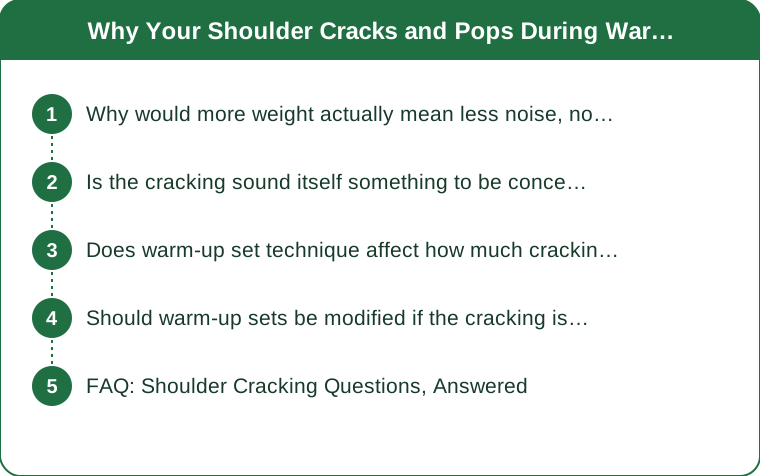
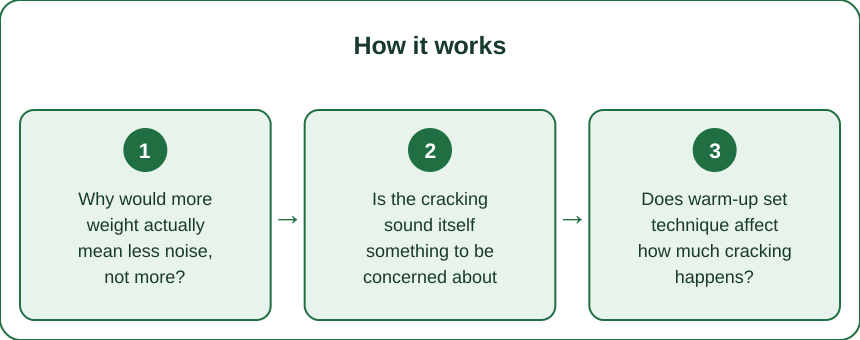
Why would more weight actually mean less noise, not more?
It seems counterintuitive, but heavier loads demand stronger stabilizer engagement to control the joint safely, which pulls the humeral head into more consistent, centered contact within the socket. Lighter loads don’t require the same stabilizer activation, so the joint has more freedom to move slightly looser through its range — and that looser movement is what tends to produce cracking sounds.
Is the cracking sound itself something to be concerned about on its own?
Cracking or popping without pain, swelling, or a feeling of instability is common and generally considered benign — it’s frequently related to gas bubbles in joint fluid (similar to knuckle cracking) or tendons/ligaments moving slightly over bony surfaces. Sound alone, without other symptoms, isn’t typically a reliable indicator of joint damage. This is general information, not medical advice — persistent pain alongside the sound warrants a professional evaluation.

Does warm-up set technique affect how much cracking happens?
Yes, to some degree — moving through the range of motion slowly and deliberately during warm-up sets, rather than quickly or carelessly, can reduce how much the joint ‘searches’ for its position, which sometimes reduces the noise, even though it may not eliminate it entirely for people whose joints are simply more prone to it.
Should warm-up sets be modified if the cracking is bothersome, even without pain?
If it’s not accompanied by pain or instability, most guidance suggests it doesn’t need to be specifically avoided — but using a slightly heavier warm-up weight (still well below working weight) can sometimes reduce the looser movement pattern that produces the sound, if the noise itself is uncomfortable to experience even without physical symptoms.
FAQ: Shoulder Cracking Questions, Answered
When does shoulder cracking become something to see a doctor about?
When it’s accompanied by pain, a feeling of the joint catching or giving way, swelling, or a noticeable reduction in range of motion — sound alone usually isn’t the deciding factor.
Does this pattern (cracking light, quiet heavy) happen with other joints too?
A similar pattern can occur in other joints like the knee or hip, for largely the same reason — reduced stabilizer engagement under lighter loads.
Does age or joint health history change how much this matters?
Someone with a prior shoulder injury or ongoing joint issue should generally have new or changing noise patterns evaluated, since baseline joint condition affects how much weight to put on a new symptom.
TL;DR:
- Heavier loads recruit stabilizer muscles more actively, pulling the joint into tighter, quieter positioning
- Lighter loads allow looser joint movement through the range, which is more likely to produce cracking sounds
- Cracking without pain, swelling, or instability is common and generally not a sign of joint damage
- Pain or a sense of instability alongside the sound is what actually warrants a professional evaluation
A shoulder that’s noisy on light sets and quiet on heavy ones is a common, explainable pattern tied to stabilizer engagement — not a sign the heavier lifting is somehow the safer choice or the lighter lifting the riskier one.
Keep Reading
This article is for general informational purposes only and is not medical advice. Always consult a qualified health professional for guidance specific to you.