Why Your Desk Loads Your Shoulder Before the Gym Ever Does
Quick Answer: A desk day is a shoulder workout nobody programs: the upper trap holds a low-grade contraction for hours to suspend the mouse arm, the shoulder blade sits pulled forward around a rounded screen posture, and the rotator cuff marinates in a slightly compromised position — so the ache you feel after pressing day was often pre-loaded by Tuesday’s spreadsheet. The fixes are unglamorous and effective: get the forearm supported so the trap can stand down, bring the mouse close, and interrupt the hold with a few strategic movements — plus two cheap exercises that build the capacity your desk quietly drains.
Here is what eight hours actually does to a shoulder, and the desk-plus-training fix.

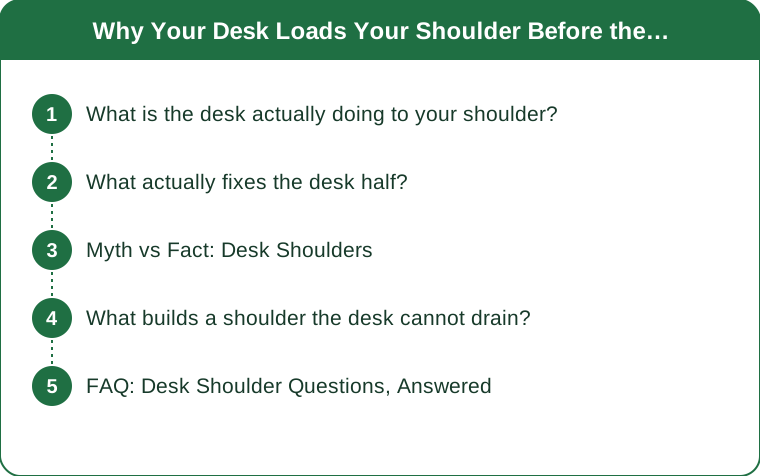
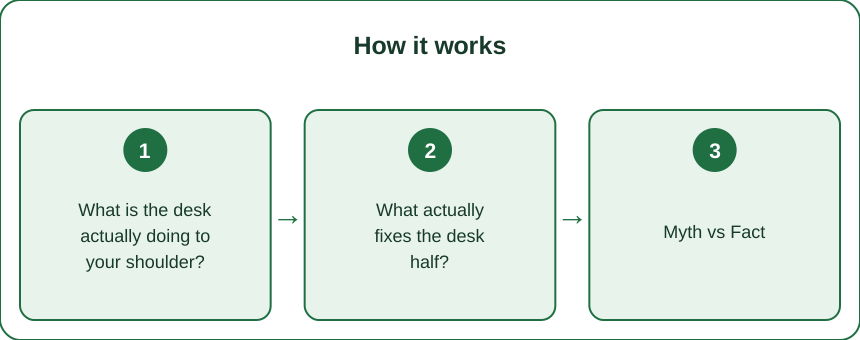
What is the desk actually doing to your shoulder?
Three slow mechanisms, all invisible while they happen.
The suspension job. An unsupported mouse arm does not rest — it hangs, and something must hold it. That something is mostly the upper trapezius, running a low-intensity contraction that never fully stops while your hand is on the mouse. The intensity is tiny; the duration is the problem. Muscles tolerate hard work with rest far better than light work without any — sustained low-grade contraction restricts the muscle’s own blood flow and produces exactly the burning, knotted upper-trap ache that desk workers assume is stress. Partly it is. Mostly it is arithmetic: thousands of seconds of holding, every day, on one side.
The position job. Screens pull heads forward and keyboards pull shoulders into protraction — the blade sliding forward and tipping around the ribcage. A forward-tipped blade slightly narrows the subacromial space, the corridor the rotator cuff tendons pass through. Nothing is damaged by sitting there; the geometry is just worse, and every overhead reach performed from that starting position works the cuff at a small disadvantage. Hold the posture forty hours a week and the disadvantaged position becomes the shoulder’s default map.
The disuse job. The mid and lower trapezius and the external rotators — the muscles that pull the blade back and down and keep the ball centered in the socket — do almost nothing all day at a desk. The shoulder system tilts: front and upper structures overworked and shortened, back and lower structures underworked and long. That imbalance is the exact pattern the classic gym shoulder complaints grow in.
Then Thursday arrives, and this pre-loaded shoulder meets a pressing session. The gym takes the blame because the gym is where it finally spoke — but the interview started Monday at nine.
What actually fixes the desk half?
Support, proximity, and interruption — in that order of payoff.
Give the forearm a home. The single highest-value change: the mousing forearm supported — by chair armrest raised to elbow height, or by desk surface with the chair pulled in — so the trap’s suspension contract is cancelled. The test is immediate: with the forearm genuinely supported, you can feel the upper trap let go. If your armrests are too low, too far apart, or missing, the trap is the armrest, all day. This is also the honest answer on armrests-versus-no-armrests debates: for mouse-heavy work, a correctly-set armrest beats posture willpower every single week.
Bring the mouse inside your footprint. Every inch the mouse sits away from your body adds reach, and reach is held by the shoulder. Mouse beside the keyboard edge, elbow hanging under the shoulder, not ahead of it. Keyboard shortcuts for your most-repeated actions retire thousands of reaches a month without a single purchase.
Raise the screen, unload the neck-shoulder chain. Top of the monitor near eye height so the head stacks over the ribs. A forward head is handed to the same upper trap that was already doing the mouse job — laptop-on-desk posture bills the shoulder twice.
Interrupt the hold on a schedule the body notices. The pattern that beats any single stretch: brief, frequent posture resets — a few per hour. The two worth wiring in: the shoulder roll to the back pocket — up, back, and down, letting the blade settle — and the doorway or desk-edge chest opener for twenty seconds at natural breaks. Neither builds anything; both un-hold what the desk has been holding, which is precisely the missing event in a desk day.
Warm the position before it works. On training days, sixty seconds of band pull-aparts and arm circles before pressing takes a shoulder from desk-map to gym-map — starting a press session in hour-nine posture is how the desk and the gym co-sign the same complaint.

Myth vs Fact: Desk Shoulders
Myth: good posture means holding your shoulders back all day. Fact: a rigid military hold is just a different sustained contraction — trading one endurance job for another. The evidence-backed goal is movement variability: your best posture is your next posture, changed often. The resets exist to keep positions rotating, not to enforce one.
Myth: an ergonomic chair fixes shoulder pain. Fact: equipment sets the stage; the loading pattern writes the play. A perfect chair with the mouse eight inches too far away still runs the suspension contract. Setup, proximity, and interruption together do what no single purchase does — and most of the fix list above is free.
Myth: my shoulder hurts at the gym, so the gym is the problem. Fact: sometimes — programming and technique matter. But a shoulder that aches on the mouse side, tightens by afternoon, and complains mostly on pressing movements is usually reporting a desk-loaded starting position meeting load. Fix the forty hours and the four gym hours often stop complaining on their own.
Myth: massage and rubbing the knot out solves it. Fact: soft-tissue work on the upper trap feels genuinely good and buys hours of relief — while the suspension job that built the knot resumes at the next mouse click. Relief tools are the wrong category; the job description is what needs editing.
Myth: stretching the tight upper traps is the cure. Fact: half at best. The upper trap is usually overworked, not just short — and its teammates below are undertrained. Stretching one side of an imbalance without strengthening the other rearranges the discomfort. The pull-apart family is the other half.
Myth: standing desks solve the shoulder. Fact: standing changes the hips and back story more than the shoulder story — a standing mouse arm reaches and hangs identically. Standing helps by forcing position changes; the mouse-side rules apply at every desk height.
What builds a shoulder the desk cannot drain?
Two cheap exercises, one weekly structure, and clear lines for when it is past self-management.
The band pull-apart — the anti-desk movement. A light band at shoulder height, arms long, pulled apart until the band touches the chest, squeezing the blades together and down, slow return. It trains the mid-trap and rear shoulder — the exact muscles the desk furloughs — in the exact direction the desk reverses. Two or three sets of fifteen, most days; it takes ninety seconds and pairs perfectly with a kettle boiling.
External rotations — the cuff’s insurance policy. Elbow pinned at your side, band or light dumbbell, rotating the forearm outward under control. Unimpressive to watch, disproportionately protective to do — centering strength for the ball-and-socket that spends its weeks in the forward map. Two sets of twelve per side, three times a week.
The weekly structure: resets and setup daily; pull-aparts near-daily; external rotations on training days; and in the gym, an honest pull-to-push ratio — desk workers thrive nearer two pulls per push, weighted toward rows and face pulls, the gym-sized versions of the same corrective vote. None of this requires new gear beyond a five-dollar band that lives on the desk itself — visibility being most of adherence. Wear whatever you would move in anyway; the entire kit is a band and ninety seconds.
The escalation lines, stated plainly: numbness or tingling down the arm, pain radiating past the elbow, night pain that wakes you, sudden loss of strength or range, or an ache that survives six honest weeks of setup-plus-exercise — those are assessment territory, a physical therapist or physician, not a longer stretching list. Shoulders have a short list of conditions that mimic desk strain and deserve real diagnosis. This is general information, not medical advice.
The satisfying part of desk-shoulder work is how fast the arithmetic turns: cancel the suspension contract, rotate positions, and add ninety daily seconds of the reverse direction — most desk shoulders feel the difference inside two weeks, and the gym stops being the scapegoat by the month’s end.
FAQ: Desk Shoulder Questions, Answered
Why is it always my mouse-side shoulder?
Because that side runs the suspension-and-reach job all day while the other arm mostly rests on the keyboard. The asymmetry is the fingerprint of the cause — and switching mouse hands occasionally, awkward as it feels, is a legitimate load-sharing tactic some desk workers swear by.
Is a vertical mouse or trackpad worth it?
A vertical mouse changes the forearm rotation, which mainly helps wrist and elbow complaints; the shoulder cares more about where the mouse sits than what shape it is. Buy proximity and forearm support first — they are free — and hardware second.
My shoulder clicks and pops at the desk. Should I worry?
Painless clicking in a shoulder that works normally is common and usually meaningless — tendons and bursae moving over structures. Clicking with pain, catching, or weakness joins the escalation list above. The click alone is not a diagnosis; the pattern around it is what matters.
Can I just fix this with more gym work instead of changing my desk?
Training helps enormously — capacity is protective — but four hours of good training rarely out-argues forty hours of bad loading. The combination is the cure: desk changes remove the drain, training builds the reserve. Either alone is half a fix, and the desk half is the cheaper one.
TL;DR:
- The desk loads the shoulder through three quiet mechanisms: the trap’s all-day suspension of the mouse arm, the forward-blade screen posture, and total furlough of the rear-shoulder muscles.
- Fix the hours first: forearm genuinely supported, mouse inside your footprint, screen at eye height, and brief posture resets a few times per hour.
- Build the reverse direction cheaply: daily band pull-aparts, external rotations on training days, and a pull-heavy gym ratio.
- Escalate real red flags — numbness, night pain, radiating pain, weakness, or six stubborn weeks — to a professional instead of a longer stretch list.
Today, make two changes that cost nothing: pull the mouse three inches closer and raise the armrest to elbow height. Your upper trap will file its first quiet shift in years by Friday.
Keep Reading
This article is for general informational purposes only and is not medical advice. Always consult a qualified health professional for guidance specific to you.