Why 'Sit Up Straight' Doesn't Actually Fix Phone-Scrolling Shoulder Rounding
Quick Answer: ‘Sit up straight’ doesn’t fix phone-related shoulder rounding because it only addresses the moment, not the underlying muscle imbalance — chest and front-shoulder muscles get chronically tight from the forward phone position while upper back muscles get chronically weak, so the actual fix requires both stretching the front and strengthening the back, not just a posture correction in the moment.

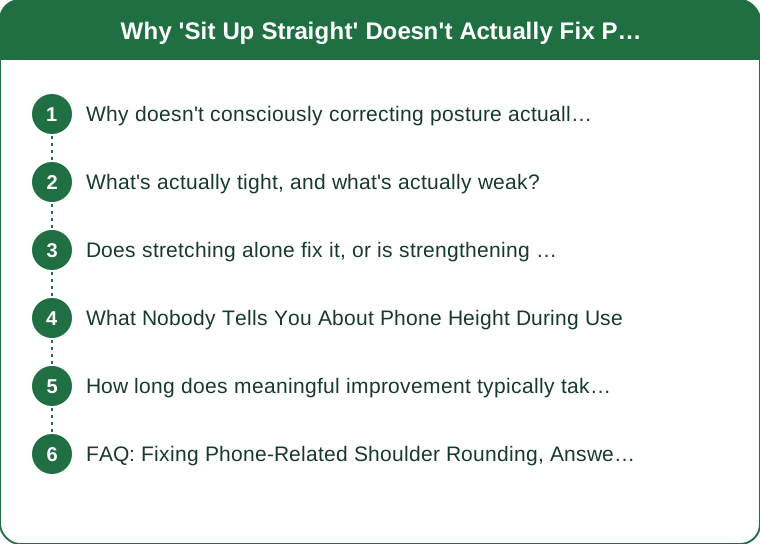
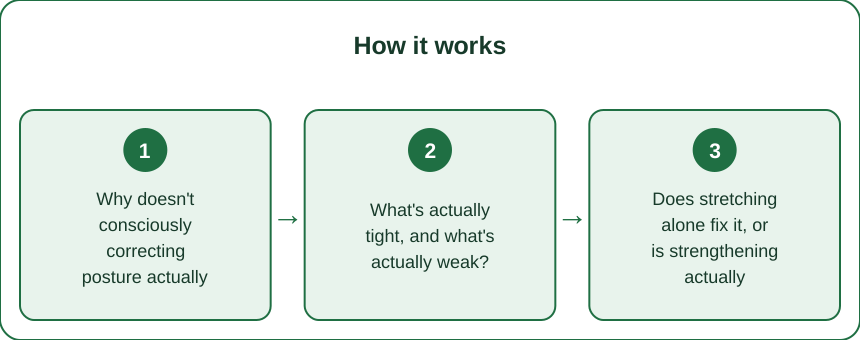
Why doesn’t consciously correcting posture actually solve this long-term?
Consciously pulling shoulders back temporarily overrides the posture without changing the underlying muscle imbalance causing it — the moment focus shifts away, the same tight chest muscles and weak upper back muscles pull the shoulders right back into the rounded position.
What’s actually tight, and what’s actually weak?
The pectoral (chest) muscles and front shoulder muscles typically become chronically shortened and tight from the sustained forward, rounded position, while the rhomboids and mid-back muscles that pull shoulders back become correspondingly weak from disuse in that same posture — both sides of this imbalance need addressing.
Does stretching alone fix it, or is strengthening actually necessary too?
Stretching the tight chest muscles alone provides only temporary relief without the strengthening component — the weak upper back muscles still can’t hold the corrected position without added strength, so lasting improvement requires both, not either alone.

What Nobody Tells You About Phone Height During Use
Holding the phone higher, closer to eye level rather than in the lap, reduces the forward head and rounded shoulder angle significantly during actual use — this doesn’t replace stretching and strengthening work, but it reduces how much damage accumulates during the many daily minutes of phone use.
How long does meaningful improvement typically take with consistent work?
Most people notice a real difference within 4-6 weeks of consistent daily stretching and 2-3 weekly strengthening sessions, though the imbalance took months or years to develop, so expecting a quick full correction isn’t realistic — steady, consistent work is what actually produces lasting change.
FAQ: Fixing Phone-Related Shoulder Rounding, Answered
What’s a simple daily stretch that targets the tight chest muscles specifically?
A doorway chest stretch (arm bent at 90 degrees against a doorframe, gently leaning forward) directly targets the pectoral tightness contributing to rounded shoulders.
What’s a simple strengthening exercise for the weak upper back muscles?
Band pull-aparts or reverse flys, done a few times weekly, directly strengthen the rhomboids and mid-back muscles that pull shoulders into correct position.
Does this rounding reverse completely, or does some change become permanent?
Most muscle imbalance-based rounding does meaningfully improve and often substantially reverses with consistent work, though very long-term postural changes may take longer or plateau at partial improvement.
TL;DR:
- ‘Sit up straight’ overrides the posture temporarily without fixing the underlying imbalance
- Chest muscles get tight while upper back muscles get weak — both need addressing
- Stretching alone gives only temporary relief without added strengthening work
- Real improvement typically takes 4-6 weeks of consistent stretching and strengthening
The forward-rounded position is a muscle imbalance problem, not a willpower or reminder problem — treating it as one is why ‘just sit up straight’ never actually sticks.
Keep Reading
This article is for general informational purposes only and is not medical advice. Always consult a qualified health professional for guidance specific to you.