Why Scrolling Your Phone Rounds Your Shoulders More Than Sitting at a Desk Does
Quick Answer: Holding a phone pulls the arms and shoulders forward and slightly inward for extended periods, engaging chest muscles while leaving upper back muscles idle — a more concentrated rounding position than typical desk posture, which is part of why phone use often does more damage in less time.
Same number of hours hunched over a desk used to be the main posture complaint — now it’s the phone, held for a fraction of the time, doing more visible damage.

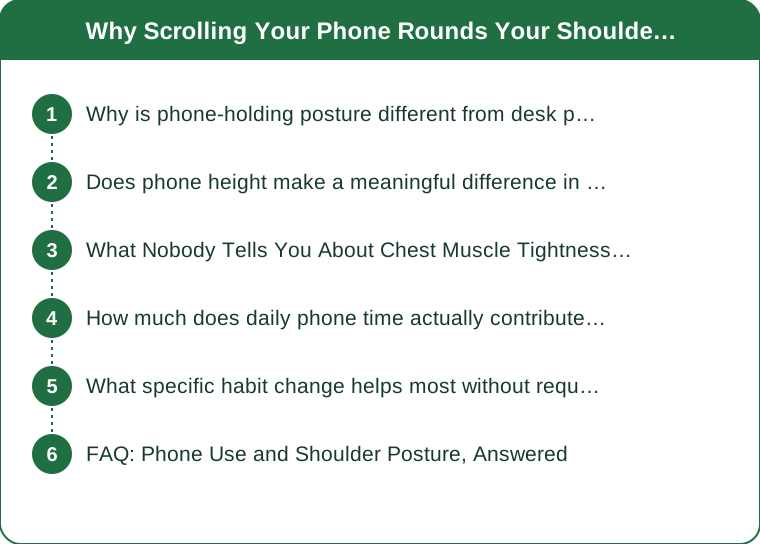
Why is phone-holding posture different from desk posture in its effect on shoulders?
At a desk, forearms often rest on a surface, providing some support that reduces sustained muscle engagement. Holding a phone requires the arms to stay elevated and unsupported, which keeps chest muscles actively engaged and shortened for the entire duration, while the upper back muscles that would normally counterbalance that position stay passive — a more one-sided muscular pattern than most desk setups create.
Does phone height make a meaningful difference in how much rounding occurs?
Yes, significantly — a phone held low, near waist or lap height, requires the head and shoulders to drop and round forward to see the screen, while raising the phone to closer to eye level keeps the neck more neutral and reduces (though doesn’t eliminate) the shoulder-rounding demand, since the arms are still elevated and unsupported either way.
What Nobody Tells You About Chest Muscle Tightness and Shoulder Rounding
Most posture advice focuses on strengthening the upper back, but tight, shortened chest muscles from repeated forward arm positions actively pull the shoulders forward regardless of how strong the back muscles are. Stretching the chest (like a doorway stretch) is often a missing half of the fix — strengthening the back without addressing chest tightness means fighting a muscular tug-of-war the back can’t fully win.

How much does daily phone time actually contribute compared to other rounding sources?
For many people now, phone use accounts for more cumulative forward-shoulder time than desk work, simply due to how often phones are checked throughout the day in short bursts that add up — even without long single sessions, the repeated brief exposure has a cumulative effect similar to longer sustained postures.
What specific habit change helps most without requiring a full posture overhaul?
Bringing the phone up toward eye level rather than dropping the head down to it, combined with taking brief breaks to open the arms out and squeeze shoulder blades together every so often during longer scrolling sessions, directly counters the muscular pattern phone use creates without needing a dedicated exercise routine.
FAQ: Phone Use and Shoulder Posture, Answered
Does using a phone stand or holder help reduce shoulder rounding?
Yes, for stationary use — a stand that positions the phone higher and hands-free removes the sustained arm elevation that drives much of the rounding effect.
Are shoulder blade squeezes enough to counter hours of phone use?
They help as a periodic reset but work best combined with chest stretching, since squeezes alone don’t address the shortened chest muscles pulling shoulders forward.
Does this posture pattern affect neck pain as much as shoulder rounding?
Often yes — the same forward head and shoulder position associated with phone use is a common contributor to neck tension, since the two postural issues tend to develop together.
TL;DR:
- Unsupported arms during phone use keep chest muscles engaged longer than typical desk posture
- Low phone height increases neck and shoulder rounding more than eye-level use
- Tight chest muscles are an often-missed half of the shoulder-rounding problem
- Frequent short phone sessions can add up to more cumulative strain than expected
- Raising phone height plus periodic chest stretches directly counters the pattern
The fix isn’t putting the phone down — it’s changing where you hold it and stretching what it tightens.
Keep Reading
This article is for general informational purposes only and is not medical advice. Always consult a qualified health professional for guidance specific to you.