How to Tell Whether Your Shoulder Needs Mobility or Stability Work
Quick Answer: If your passive range is good but your active range is limited, meaning someone or something else can move your arm further than you can move it yourself, you have a stability and control problem, and stretching will make it worse. If both passive and active range are limited equally, you have a genuine mobility restriction. The most common self-misdiagnosis is a hypermobile shoulder that feels tight because the muscles are working overtime to create stability, and it gets stretched daily for months while getting steadily worse.
The word tight describes a sensation, and that sensation has at least two opposite causes.
This blog has covered why your shoulder feels worse on days you do nothing, why it hurts only during overhead press, and why your shoulders feel tightest first thing in the morning. This is the assessment that tells you which problem you have.

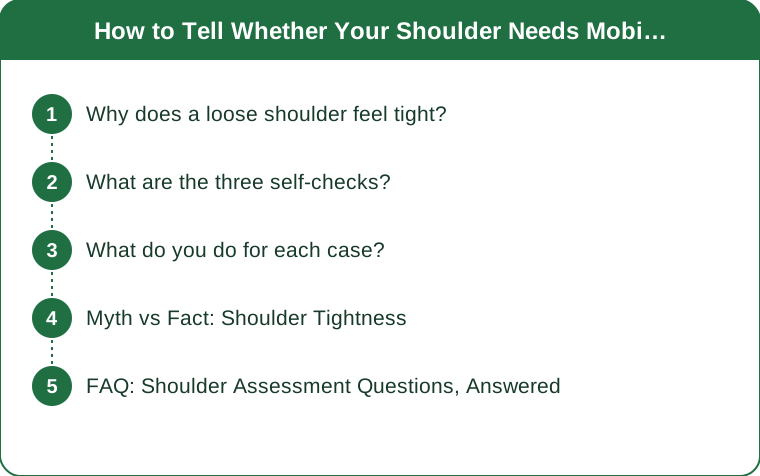
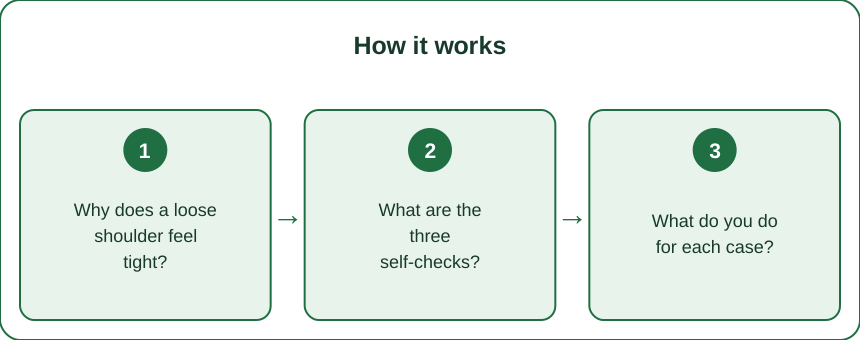
Why does a loose shoulder feel tight?
Because muscles create tension to compensate for a joint that is not stable, and that tension is what you feel.
The shoulder trades stability for range by design. It is the most mobile joint in the body, and it achieves that by having a shallow socket and relying heavily on muscles and connective tissue for control.
When passive structures do not provide enough stability, muscles take over. Muscles held in a constant low-level contraction to protect a joint feel exactly like tight muscles, because they are contracted.
Stretching a muscle that is working to stabilise removes stability. The relief lasts perhaps twenty minutes, then the muscle contracts again, harder, because the joint is now less protected. This is why people stretch daily for months and never resolve anything.
The recurring pattern of temporary relief is the diagnostic clue. If stretching feels great and the tightness returns within an hour, every time, for weeks, the tightness is not the problem. It is the response to the problem.
Genuine mobility restriction behaves differently. Progressive stretching over weeks produces lasting improvement in range. If you are doing consistent mobility work and range is not improving over four to six weeks, you have the other problem.
And this distinction is not obvious from how it feels. Both present as tightness, both feel worse after sitting, and both feel temporarily better after stretching. The difference is only visible in a comparison of active versus passive range.
What are the three self-checks?
Each takes a minute and together they separate the two cases reasonably well.
Check one: active versus passive overhead reach. Lie on your back, knees bent, lower back flat. Raise both arms overhead and see how far they go before your back arches. Then have someone gently take them further, or use a wall to assist. If assisted range is substantially greater than what you can do yourself, that gap is a control problem, not a tissue restriction.
Check two: the wall test. Stand with your back, head, and both arms flat against a wall in a goalpost position, with lower back flat. Slide your arms overhead keeping contact. Note where contact breaks. Then do it lying down with knees bent, which removes some postural demand. If you are noticeably better lying down, the issue is postural control rather than shoulder tissue.
Check three: the beighton-style laxity indicators. Can you bend your thumb to touch your forearm? Do your elbows hyperextend past straight? Do your little fingers bend back past 90 degrees? Several yes answers suggest general hypermobility, which shifts the likely diagnosis strongly toward stability rather than mobility.
Compare left to right on all of them. Asymmetry is more informative than any absolute measurement, and most people have a meaningful difference they have never noticed.
Film yourself for check one and two. You cannot see your own shoulder position and your perception of where your arm is will not match reality.
And note whether pain appears at end range or throughout. Pain only at the very end of range points more toward an impingement pattern; pain through the whole movement is a different conversation and warrants assessment.

What do you do for each case?
Genuinely different programs, and the wrong one is counterproductive rather than merely useless.
If it is a mobility restriction: progressive loaded stretching rather than passive holds. Work at end range with light load, holds of 30 to 60 seconds, several times a week. Add thoracic spine mobility work, since a stiff upper back limits shoulder overhead range substantially and is frequently the actual restriction. Expect measurable change over four to six weeks.
If it is a stability problem: stop stretching it and start loading it. Controlled strength work through the range you already have, particularly in the positions where you feel unstable. Rotator cuff work, serratus anterior activation, and scapular control drills. Slow tempo, moderate load, high attention to position.
For stability, end-range strength is the specific goal. Being strong in the positions where you feel loose is what creates active stability. Isometric holds at end range are a good starting point.
Both cases benefit from thoracic spine work. It is the one thing that helps either way, which makes it a safe default while you work out which problem you have.
Progress slowly in both cases. Shoulder tissue adapts slowly and it is easy to flare. Two to three sessions a week, small increments.
And if you are hypermobile generally, treat that as the frame for everything. Hypermobile people need more stability work and less stretching across their whole body, and shoulder-specific advice written for the general population frequently makes things worse.
This is general information, not medical advice. Shoulder pain with weakness, night pain, pain radiating down the arm, numbness, or a history of dislocation needs proper assessment by a physiotherapist or doctor rather than self-management.
Myth vs Fact: Shoulder Tightness
Myth: Tightness always means you need to stretch. Fact: Tightness is a sensation with at least two opposite causes. A hypermobile shoulder generating protective muscle tension feels identical to a genuinely restricted one, and stretching it makes it worse.
Myth: If stretching feels good, it is helping. Fact: Temporary relief that reliably disappears within an hour, repeated for weeks, is a sign you are treating a symptom. Genuine mobility work produces lasting range improvement over four to six weeks.
Myth: Shoulder problems are shoulder problems. Fact: Thoracic spine stiffness limits overhead shoulder range substantially, and scapular control determines where the shoulder socket points. A large share of shoulder complaints resolve through work that is not on the shoulder at all.
Myth: You should push into pain to improve range. Fact: Working into sharp pain reliably increases protective muscle tension and irritates tissue. Mild discomfort at end range is acceptable; sharp pain is a stop signal.
Myth: Rotator cuff work means light bands forever. Fact: The rotator cuff responds to progressive load like any other muscle. Staying at the lightest band indefinitely produces no adaptation, and progressing load is the point.
Myth: Morning stiffness means you need more stretching. Fact: Morning stiffness that eases within thirty minutes of movement is common and usually unremarkable. Stiffness lasting over an hour, particularly with joint swelling, warrants medical assessment.
FAQ: Shoulder Assessment Questions, Answered
How do I know if my shoulder needs stretching or strengthening?
Compare active to passive range. If assisted movement goes noticeably further than what you can do yourself, it is a control and stability problem and stretching will make it worse. If both are limited equally, it is a genuine mobility restriction.
Why does my shoulder feel tight even though I stretch daily?
Most likely because the tightness is protective muscle tension around a joint lacking stability. Stretching removes the protection temporarily, the muscle re-tightens harder, and the cycle repeats. Strength work through your available range is the fix.
Can thoracic spine stiffness cause shoulder problems?
Yes, frequently. Overhead shoulder range depends on the upper back extending, and a stiff thoracic spine limits it substantially. Thoracic mobility work helps in both the mobility and the stability case, which makes it a safe default.
TL;DR:
- Compare active range to passive range. A large gap means a stability problem; equal limitation means a genuine mobility restriction.
- Stretching a shoulder that is tight for stability reasons makes it worse, and the giveaway is relief that vanishes within an hour, every time.
- Mobility case: loaded end-range stretching plus thoracic spine work, expecting change over four to six weeks.
- Stability case: stop stretching, load through your existing range, and build end-range strength with rotator cuff and scapular control work.
Thoracic spine mobility helps either way, so it is the safe thing to start with while you work out which problem you have.
Keep Reading
This article is for general informational purposes only and is not medical advice. Always consult a qualified health professional for guidance specific to you.