Is Carrying Your Bag on One Shoulder Actually Causing Your Shoulder Pain?
Quick Answer: Yes — consistently carrying weight on one shoulder can contribute to muscle imbalance and tension over months or years, especially with bags over 10-15% of body weight. Switching sides regularly and choosing a crossbody reduce the effect.
You’ve always carried your bag on the right shoulder. It’s just habit at this point. But if that same shoulder is the one that’s tight, achy, or sits slightly higher than the other, the habit and the ache are probably connected.

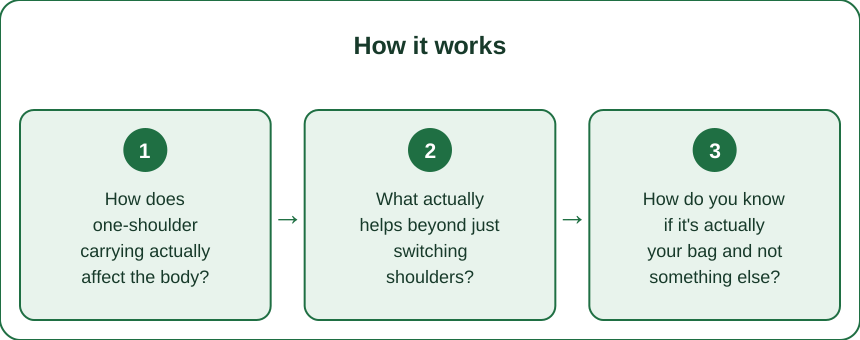
How does one-shoulder carrying actually affect the body?
Carrying weight consistently on one side causes the trapezius on that side to stay slightly elevated to keep the strap from sliding, which over months becomes a default resting position even without the bag. This can create a visible shoulder height difference and one-sided neck tension.
The effect scales with bag weight — a bag over roughly 10-15% of body weight carried the same way daily is where physical therapists start seeing measurable postural asymmetry.
What actually helps beyond just switching shoulders?
Switching the bag to the opposite shoulder every day (not just when one side gets tired) prevents either side from adapting into a fixed elevated position. A crossbody style distributes weight across the body rather than loading one shoulder entirely, which is the single biggest structural fix.
Strengthening the mid-back and rear shoulder muscles with simple resistance work also helps the body resist the pull of an asymmetric load, regardless of which bag you carry.

How do you know if it’s actually your bag and not something else?
If the tight or elevated shoulder is consistently the same side you carry your bag on, and it eases noticeably on days you don’t carry it, that’s a strong sign the habit is a real contributing factor rather than an unrelated issue.
If pain persists on days without the bag, or radiates down the arm or into the hand, that’s a signal to see a physical therapist rather than just changing bag habits.
What Nobody Tells You About Bag-Related Shoulder Pain
Most people assume shoulder pain is from a workout or sleeping position and never connect it to a bag they’ve carried the same way for a decade. The habit is so automatic it doesn’t register as a variable worth testing — but it’s often the easiest one to change and see quick results.
A simple two-week experiment — switching sides daily or using a crossbody — is a low-effort way to test whether your bag is actually the cause before assuming it’s something more complicated.
FAQ: Shoulder Bag and Posture Questions, Answered
How heavy is too heavy for one-shoulder carrying?
As a general guide, keep a single-shoulder bag under roughly 10% of your body weight if you carry it the same way daily.
Does a backpack solve the problem entirely?
Mostly yes — a backpack with both straps used distributes weight evenly, which is why it’s often recommended over any single-shoulder style for heavier daily loads.
When should shoulder pain see a professional instead of a bag swap?
If pain radiates down the arm, causes numbness, or persists on days without carrying anything, see a physical therapist — this is general information, not medical advice.
TL;DR:
- Daily one-shoulder carrying can contribute to real muscle imbalance over months
- Switching shoulders daily and using a crossbody are the simplest fixes
- Test whether pain eases on no-bag days to confirm the connection
- Persistent or radiating pain needs a professional, not just a bag change
This is general information, not medical advice — see a professional for pain that doesn’t improve.
Keep Reading
This article is for general informational purposes only and is not medical advice. Always consult a qualified health professional for guidance specific to you.